Digital Banking for First-Time Users: What to Expect
Introduction: Your First Step into Digital Banking
Banking used to mean lining up at a branch, filling out forms, and waiting for your number to be called. Today, a growing part of everyday banking can happen right from your phone. Welcome to digital banking for beginners, luv. ♥
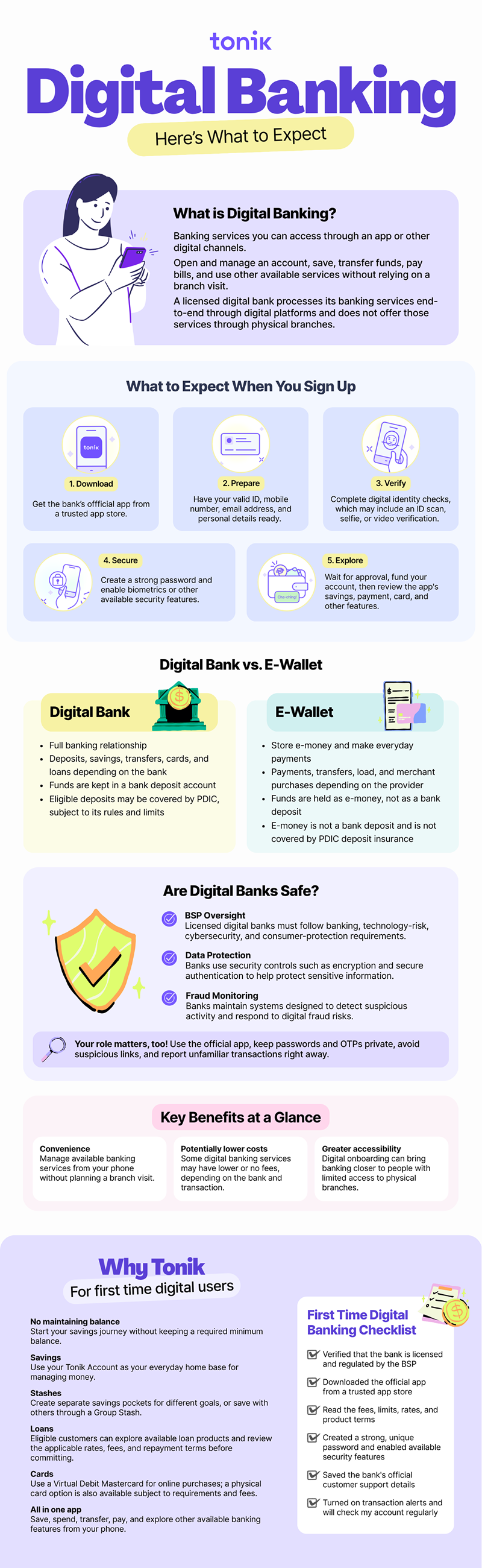
But what is a digital bank in the Philippines, exactly? Under Bangko Sentral ng Pilipinas (BSP) regulations, a digital bank is a bank that offers financial products and services through digital platforms or electronic channels, with transactions processed end-to-end digitally and without physical branches offering banking services. In simple terms, you can open and manage an account, save money, transfer funds, pay bills, and access other banking services using your phone or other connected device.
And Filipinos are becoming more comfortable doing exactly that. According to the BSP, 57.4% of retail payment transactions in the Philippines were already digital in 2024, up from 52.8% in 2023 and just 20.1% in 2020. The BSP also reported that 59 banks offered digital account onboarding as of the second quarter of 2024, making it possible for more customers to start their banking journey without necessarily visiting a branch.
So, if you're exploring digital banking for beginners, you're definitely not alone. In this guide, we'll break down how digital banks work, what makes them different from traditional banks and e-wallets, their benefits, and what you should check before opening your first digital bank account.
Table of Contents
How Digital-Only Banks Operate
So, how do digital banks work without the usual bank branches? Simple: for anyone exploring digital banking for beginners, most of the banking experience happens online—from opening your account to managing your money and getting help when you need it.
No Physical Branches
One of the biggest differences between a digital bank vs traditional bank is the branch setup. Under BSP regulations, a digital bank offers financial products and services that are processed end-to-end through digital platforms or electronic channels, without physical branches, sub-branches, or branch-lite units offering those banking services.
That means a digital-only bank in the Philippines is designed so you can do most of your banking wherever you have access to your phone and the internet—no branch visit required.
Customer Support Goes Digital, Too
No branch doesn't mean no help, luv. ♥ Since digital banks operate online, customer assistance can also be provided through channels such as mobile apps, live chat, email, messaging, or phone support.
BSP consumer protection rules require supervised financial institutions to provide accessible channels for customers to submit inquiries, requests, and complaints. These may include mobile apps, email, web-based platforms, live chat, and telephone support.
So, if something goes wrong with your account, you should still have a way to reach your bank—you'll just be doing it digitally instead of walking up to a teller.
Digital Verification
Even account opening can happen online. Banks may use electronic Know-Your-Customer (e-KYC) processes to verify a customer's identity digitally.
The BSP defines e-KYC as the electronic verification of a customer's credentials and allows BSP-supervised financial institutions to use digital identification systems for customer identification and verification. These systems must meet requirements around security, reliability, governance, and risk management.
For anyone wondering how to open a digital bank account in the Philippines—especially anyone learning about digital banking for beginners—this digital verification process is one of the reasons you may be able to complete your application without visiting a physical branch. Exact requirements and verification methods can still vary depending on the bank.
Safety & Regulation: Are Digital Banks Safe in the Philippines?
Putting your money in an app instead of a physical branch can feel like a big leap, especially if it's your first time. So, are digital banks safe in the Philippines? It's one of the biggest questions around digital banking for beginners.
Legitimate BSP-licensed digital banks operate under banking, cybersecurity, risk-management, and consumer-protection requirements set by the Bangko Sentral ng Pilipinas (BSP).¹
Here are some of the safeguards behind the scenes:
BSP Oversight
Digital banks are officially recognized as a type of bank under BSP regulations—not simply as apps or fintech platforms. Before a digital bank can operate, it must meet BSP licensing and regulatory requirements covering areas such as capital, governance, risk management, technology, cybersecurity, and consumer protection.¹
The BSP also requires applicants for digital banking licenses to have their supporting IT systems and infrastructure independently assessed, including their security controls, resilience, databases, networks, and anti-money laundering systems .
For extra peace of mind, you can check whether a financial institution is BSP-regulated through the BSP Online Verification System before opening an account.
Data Encryption and Security
Your personal and financial information needs protection as it travels between your device and the bank.
BSP electronic banking security guidelines require banks to use encryption appropriate to the sensitivity of the information being protected. The guidelines also call for strong end-to-end encryption when highly sensitive information, such as customer passwords, is transmitted.
BSP's financial consumer protection framework also requires supervised financial institutions to maintain information-security guidelines, secure databases, IT-security infrastructure, and procedures for protecting customers' personal information.
Fraud Monitoring
Digital banks don't just wait for customers to report something suspicious. BSP regulations require supervised financial institutions to maintain automated, real-time fraud monitoring and detection systems appropriate to the risks of their digital platforms. These systems are expected to help identify and block suspicious or fraudulent online transactions and adapt as fraud patterns evolve.
Of course, no banking platform can eliminate every scam or cyber threat. Your habits matter, too: keep your passwords and OTPs private, avoid suspicious links, and immediately report transactions you don't recognize.
The good news? With a legitimate BSP-licensed digital bank, digital banking combines the convenience of an app with regulatory and security requirements designed to help protect your money and information. That reassurance matters when learning about digital banking for beginners.
Key Benefits of Digital Banking
Why are more Filipinos giving digital banking a try? For first-time users, especially those exploring digital banking for beginners, some of the biggest benefits of digital banking come down to three things: convenience, potentially lower costs, and easier access to financial services.
Convenience
With a digital bank, your phone can become your bank branch. You can manage your account, transfer money, pay bills, and access other available banking services all in the comfort of your own home.
In fact, the BSP's National Retail Payment System aims to give Filipinos easy access to accounts that allow them to make payments, receive money, or transfer funds anytime and anywhere using a digital device.
For anyone balancing work, school, family, or a busy commute, that can make everyday money management a whole lot easier.
Potentially Lower Fees
Another possible advantage of a digital-only bank in the Philippines is lower costs for certain services.
Because digital financial services can operate at scale using technology, the World Bank notes that they have the potential to lower costs and increase transaction speed. But remember, luv: this doesn't mean every transaction at every digital bank is automatically free.
Transfer fees, account charges, and other costs still depend on the bank and the service you use. The BSP publishes transfer-fee disclosures for supervised financial institutions, and these show that PESONet and InstaPay charges can vary—including some transactions that are offered for free.
Some digital banking products may also offer features such as no maintaining balance, but always check the specific bank's latest fees, minimum balance requirements, and terms before signing up.
Greater Accessibility
Digital banking can also help bring formal financial services closer to people who may have limited access to a physical bank branch.
The BSP's financial inclusion strategy specifically promotes digital financial services as a way to expand access, particularly for unserved and underserved Filipinos.
Digital onboarding makes this even easier: as of the second quarter of 2024, the BSP reported that 59 banks offered digital account-opening capabilities.
So, whether you live far from a branch or simply prefer managing your money through your phone, an online-only bank in the Philippines can make banking more accessible—as long as you have the necessary device, connectivity, and can meet the bank's account requirements.
For digital banking for beginners, that's really the appeal: banking that can fit more easily into your everyday life.
Digital Banking with Tonik Bank
Ready to put all that digital banking knowledge into action, luv? ♥ That's where digital banking for beginners starts to feel real.
Tonik Digital Bank, Inc. is a licensed digital bank in the Philippines regulated by the Bangko Sentral ng Pilipinas (BSP). It offers savings, loans, payments, and cards through its mobile banking platform. Tonik is also listed by the BSP among the country's authorized digital banks.
And yep—your Tonik Account comes with no maintaining balance, so you can start saving without worrying about keeping a required minimum amount in your account.
What Can You Expect?
Getting started is designed to be simple and digital. You can open and manage your Tonik Account through the app, with access to features that help you save, spend, and borrow in one place. All the features of a bank at your fingertips.
A few things you can explore:
- Savings: Keep your money in your Tonik Account or grow it through available savings products.
- Stashes: Create separate savings pockets for different goals—or even save together with your besties through a Group Stash.
- Loans: Eligible customers can explore loan products such as Tonik Credit Builder Loan and Shop Installment Loan, with the applicable rates, fees, and repayment terms disclosed before the loan takes effect.
- Cards: Tonik customers receive a Virtual Debit Mastercard for online purchases, with a physical debit card option also available subject to applicable requirements and fees.
Basically, you've got your saving, spending, and borrowing needs right in your pocket. That's digital banking in the Philippines made simple, luv. It's digital banking for beginners with a little more confidence.