
Promotional Savings Rates in the Philippines: Guaranteed?
⚡ Quick Take
Usually not, Luv. Most advertised savings rates are a base rate plus a conditional bonus, and the big number on the banner is the two added together under conditions most people won't meet every single month. The usual tricks are balance caps (the rate stops at a peso limit), tasks or spending requirements, average daily balance targets, tiers, and promo periods with an end date. Base rates can change too, and the new rate usually applies to money you've already deposited. Time deposits are the exception, since the rate locks when you open one and holds for the whole term. So when you're sizing up promotional savings rates in the Philippines, skip the headline and ask what you'll actually earn on your own balance. This guide shows you how.
Table of Contents
- ⚡ Quick Take
- Base Rate and Headline Rate Are Different Numbers
- The Five Mechanisms Behind a Promotional Rate
- When a Rate Can Change on Money You've Already Deposited
- How to Find the Rate You'll Actually Earn
- What Tonik Pays, and the Conditions Attached
- How We Checked These Rates
- FAQ
- Sana All Read the Fine Print
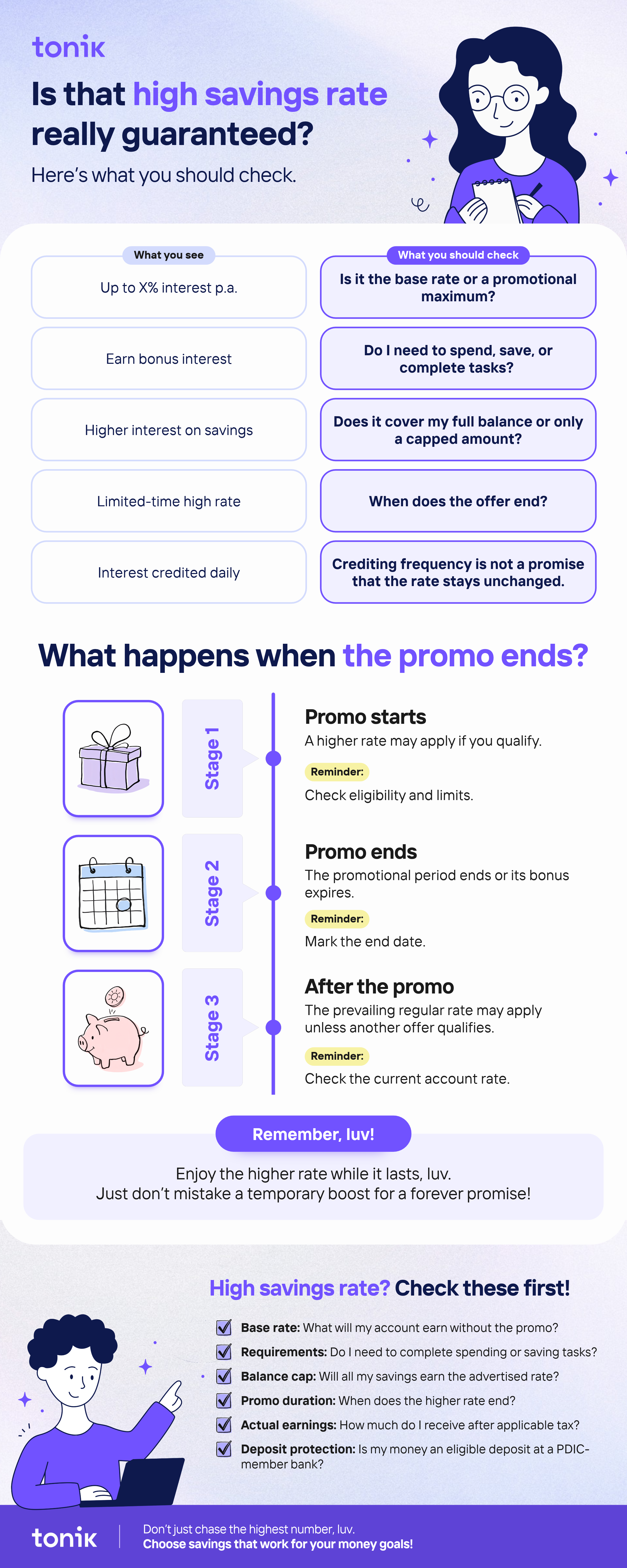
Base Rate and Headline Rate Are Different Numbers
Every savings account has two numbers worth knowing. The base rate is what you earn if you do nothing extra: no missions, no minimum spend, no growth target. The headline rate is the maximum, paid only when every condition lines up. Guess which one ends up on the billboard. (Grabe, not even close.)
Here's how that plays out on ₱100,000 over a year. Account A advertises "up to 8% p.a." Its base rate is 3.5%, and a 4.5% bonus applies to the first ₱10,000 only, in months when you complete the required tasks. Account B pays a flat 4% p.a. on everything, with no conditions.
Interest on ₱100,000 for 12 months | Account A ("up to 8%") | Account B (flat 4%) |
|---|---|---|
You qualify for the bonus all 12 months | ₱3,950 | ₱4,000 |
You qualify 6 months out of 12 | ₱3,725 | ₱4,000 |
You never qualify | ₱3,500 | ₱4,000 |
Illustrative figures. Gross simple interest, before the 20% final withholding tax.
Even in a perfect year, the 8% account pays less. The 8% only ever touched one tenth of the money, while the 4% works on the whole balance every month, whether or not you remembered to pay a bill through the app.
Bonus rates aren't a scam, by the way. They're a real reward for people whose habits happen to fit them. The headline just describes the best case, and you're the one who has to check whether the best case is yours.
The Five Mechanisms Behind a Promotional Rate
Most promo rates you'll see from Philippine banks use one or more of these, often stacked together. Each one is perfectly legal. Each one also widens the gap between the banner and your actual interest.
Balance Caps
A balance cap means the promo rate stops at a peso limit, and everything above it earns the base rate. Maya's boosted savings rate has worked this way, with the bonus applying only to the first ₱100,000 while the rest earns the base rate (PesoHub). In ads, the cap usually sits in small print under the big number. The effect is easy to underestimate. If 10% applies to the first ₱100,000 and 3% to the rest, someone with ₱400,000 saved earns a blended 4.75%, much closer to 3 than to 10.
Ask: Up to what balance does this rate apply, and what does the rest earn?
Task and Spending Requirements
Here the bonus depends on what you do inside the bank's app each month: pay bills, buy load, scan QR codes, hit a minimum spend. Maya has described these as "missions," with the bonus rate lasting until the end of the month and then dropping back to the base rate. The ad says "up to," and those two words carry a lot of weight. In a month when you're busy, sick, or simply buying groceries somewhere else, you earn the base rate.
Ask: What exactly do I have to do every month, and what do I earn in a month I don't?
Average Daily Balance Conditions
Your average daily balance (ADB) is your balance averaged across every day of the month, so a deposit made on the 28th barely moves it. Some bonuses need a minimum ADB. Others need growth. One CIMB promotion in 2025 tied its bonus rates to growing your ADB compared with the month before (Context.ph). So the reward goes to adding money, and simply keeping it earns you nothing extra. The month you finally spend your savings on the thing you saved for, the bonus disappears.
Ask: Is the condition about holding a balance, or growing it?
Tiering
Tiered accounts pay different rates on different bands of your balance. The catch is whether a tier rate covers your whole balance once you reach it, or only the slice inside that band. In one CIMB promotion, a special 6% rate applied only up to ₱200,000 of ADB, and anything above earned the base rate of 2.5% or 2.6% (YugaTech). Banners almost never say which kind of tier you're looking at, and the difference in pesos can be big.
Ask: Does the top rate cover my whole balance, or only the part inside the tier?
Promotional Periods
Some rates come with an expiry date. A promo might run for one quarter, or only for your first few months as a new depositor, and then the rate reverts to base. A 2022 GSave promotion, for example, paid 7% for the first three months of a new account, and only on the first ₱100,000 ADB. That's a time limit and a cap stacked together, which is pretty common. Also check whether the bank tells you when the promo ends, or whether you only notice when the interest drops.
Ask: When does this rate end, and what will I earn after?
When a Rate Can Change on Money You've Already Deposited
This is the part almost nobody puts on a banner. A regular savings account has a flexible rate. The bank can change it, and when it does, the new rate generally applies to your existing balance from the effective date onward. The rate you opened with is where you start. Nobody promised you'd keep it.
Rates move for ordinary reasons. The Bangko Sentral ng Pilipinas adjusts its policy rate, competition shifts, a promo runs out. Maya, for instance, announced that its base rate would become 3% p.a. starting April 1, 2026, and a change like that applies to people already saving with it as well as new sign-ups. Every bank does this, Tonik included. So it isn't only promo rates that move. Base rates do too.
Time deposits work differently. The rate is fixed when you open one and holds for the full term, so a 12-month time deposit opened at 3.5% keeps earning 3.5% for those 12 months, even if the bank cuts rates the following week. The trade-off is access. Your money is committed for the term, and taking it out early usually costs you some or all of the interest. If you're weighing the two, our guide to time deposits vs high-yield savings walks through how to choose.
Before opening any account, find the bank's published rate page and check two things: whether each rate shows an effective date, and what the terms say about rate changes on existing balances. A bank that dates its rates and says plainly when they can change is much easier to plan around.
One thing a high rate doesn't change is safety. Deposits at BSP-licensed banks are insured by PDIC up to ₱1 million per depositor per bank, whatever the rate. What a big advertised number does put at risk is your expected interest, which we unpack in are high-interest savings accounts safe?
How to Find the Rate You'll Actually Earn
You can run this check on any savings rate you come across, ours included. It takes about ten minutes with the bank's terms open.
- Find the base rate. That's what you earn in your worst month. If the marketing page doesn't show it, the terms and conditions will.
- List every condition on the bonus. Missions, minimum spend, minimum ADB, ADB growth, new-customers-only. Then be honest about which ones you'd meet every month, not just the months you remember (charot, but also not charot).
- Apply your real balance to any cap or tier. Split your money into the part that earns the bonus and the part that doesn't.
- Check whether the rate is promotional, and when it ends. If there's an end date, plan around the base rate after it.
Then do the math on your own balance:
Blended rate = [(bonus-eligible amount × full rate) + (remaining balance × base rate)] ÷ total balance
Say you have ₱150,000 in an account paying 6% on the first ₱50,000 and 3% on the rest. That's (₱50,000 × 6%) + (₱100,000 × 3%), or ₱3,000 + ₱3,000, divided by ₱150,000. Your blended rate is 4%. If you'd only qualify for the bonus in some months, scale the bonus part down by the share of months you'd actually make it.
That's the number to compare across accounts. The account with the biggest number on its banner isn't always the one that pays you the most.
What Tonik Pays, and the Conditions Attached
Fair's fair. If we're asking you to put every other bank's rates through the four-step check, Tonik goes through it too. Here's the full rate card.
Product | Rate | Condition |
|---|---|---|
0.10% p.a. | None | |
3.25% p.a. | None | |
3.75% p.a. | Owner plus at least 2 participants | |
Time Deposit, 6 months | 4.00% p.a. | None |
Time Deposit, 9, 12, 18 or 24 months | 3.50% p.a. | None |
Time Deposit bonus | Additional 1.00% p.a. | Minimum ₱10,000 ADB every month in your Tonik savings account for the full term; paid at maturity |
Rates as of November 2026. Time Deposit rates effective August 24, 2026. For live rates, see our deposit interest rates page.
Run the check and here's what comes out. The base rate is the rate in the table, and there's no balance cap or tier where it stops applying, so a Solo Stash pays 3.25% on whatever's in it. There are no spending missions, no app tasks, and no promo period. Two conditions exist, and both are in the table: Group Stash pays 3.75% once the owner has at least two people saving into it, and the Time Deposit bonus needs a ₱10,000 ADB in your Tonik savings account every month of the term. Miss a month and you keep the base Time Deposit rate, but the extra 1% isn't paid at maturity.
Now the honest bit we asked everyone else for. Tonik savings rates can change, and a new rate applies to existing balances from its effective date. Time Deposit rates are fixed when you open and hold for the full term. And no, we won't call this the highest savings interest rate in the market. What we can say is that every condition is right there in the table, so the rate you see is the one you can plan around.
How We Checked These Rates
Tonik's rates come from our deposit interest rates page as of November 2026. The competitor examples are past campaigns, cited from each bank's own published terms and dated, because they're here to show how promotional rates are usually built. They aren't current offers. Rates change often, so always check the bank's own page before you deposit.
Tonik Digital Bank, Inc. is supervised by the Bangko Sentral ng Pilipinas. Deposits are insured by PDIC up to ₱1 Million per depositor.
FAQ
Are promotional savings interest rates in the Philippines guaranteed?
No. Most promotional rates depend on conditions like a balance cap, monthly tasks or an ADB target, and many have an end date. Even the base rate on a regular savings account can change. The rate that stays locked is a time deposit rate, which is fixed for the full term once you open it.
Can a bank lower my savings rate after I deposit?
Yes. Savings account rates are flexible, and a change generally applies to existing balances from its effective date. Check the bank's terms for how it announces changes. Time deposits are the exception, since the rate you open with holds until maturity.
What is a balance cap on a savings account?
It's the peso limit up to which a promo or bonus rate applies. Anything above the cap earns the base rate. If an account pays 10% on the first ₱100,000 and 3% after that, a ₱400,000 balance earns a blended 4.75%.
Why is my interest lower than the advertised rate?
Usually it's one of four things: part of your balance sits above a cap, you missed a monthly condition, a promo period ended, or the base rate changed. Interest is also subject to the 20% final withholding tax, so what lands in your account is lower than the gross rate.
Is a time deposit rate fixed for the whole term?
Yes. The rate is set when you open the time deposit and holds until maturity, even if the bank changes its rates in the meantime. Withdrawing early usually means losing some or all of the interest, so pick a term that matches when you'll need the money.
Sana All Read the Fine Print
Chasing the highest rate isn't wrong, bes. Just make sure it's a rate you'll actually earn. Before you move your money for a big number, take ten minutes, run the four steps, and do the math on your own balance. A bonus rate can be a great deal for the right person. The whole point is finding out whether that person is you.
Tonik's Solo Stash and Group Stash let you set money aside for specific goals, separate from your everyday spending, earning 3.25% p.a. (3.75% p.a. for a Group Stash with at least two participants) with no balance cap and no missions. For money you won't need for a while, a Tonik Time Deposit locks in up to 4% p.a. for the full term, plus an extra 1% p.a. at maturity if you keep a ₱10,000 ADB in your Tonik savings account every month.
Now you know how the trick works, Luv. Read past the headline, check the conditions, and pick the rate that fits your real life. You've got this.
XOXO,
Tonik 💜