E-wallet Vs. Digital Bank: The Differences Between the Two
Does the debate between e-wallet vs. digital bank ever cross your mind? From paying for your morning coffee to sending money to your loved ones, managing your finances has never been easier. Thanks to these two conveniences, gone are the days when you had to line up at the bank or carry cash everywhere. These days, all you need is your smartphone!
But with so many financial apps available, you might be wondering: What's the difference between an e-wallet and a digital bank? Aren't they basically the same thing?
Not quite, Luv! While both let you manage money from your phone, they serve different purposes. In this e-wallet vs. digital bank comparison, we'll break down what makes them different and which one might be the better fit for your financial needs.
Table of Contents
- A Brief History of E-Wallets and Digital Banks in the Philippines
- What Are E-Wallets?
- What Are Digital Banks?
- E-Wallet vs. Digital Bank: What's the Main Difference?
- What About Safety?
- E-Wallet vs. Digital Bank: Which Is Best for You?
- Why Not Use Both?
- Frequently Asked Questions About E-Wallets and Digital Banks
- Conclusion: E-Wallet vs. Digital Bank? You Decide!
A Brief History of E-Wallets and Digital Banks in the Philippines
Before QR codes and mobile banking became part of our daily routines, Filipinos relied heavily on cash and traditional banks for financial transactions.
Things started changing in the early 2000s with the introduction of mobile money services. Smart Money launched in the early 2000s, followed by GCash in 2004, giving Filipinos new ways to send money and make payments using their phones.
Fast forward to 2020, when the Bangko Sentral ng Pilipinas (BSP) officially introduced digital banks as a separate banking classification through.
And guess who helped lead the digital banking revolution? Yours truly! 💜
Tonik became the Philippines' first neobank to secure a digital banking license from the BSP in June 2021, following our public launch in March of the same year.
Today, e-wallets and digital banks have become essential tools for millions of Filipinos, making everyday transactions and financial services more accessible than ever.
But before diving into the e-wallet vs. digital bank debate, let's first understand what each one actually does.
What Are E-Wallets?
Think of an e-wallet as your everyday wallet, just without the bulky coins and crumpled bills!
An electronic wallet, or e-wallet, is a digital tool that lets you store electronic money and make transactions through your smartphone or another electronic device.
Instead of reaching for cash, you can simply open an app to pay for purchases, transfer money, or settle your bills.
Popular e-wallets in the Philippines include GCash and Maya's e-wallet service.
What Can You Do With an E-Wallet?
Depending on the provider, you can:
- Pay bills: Settle electricity, water, internet, and other bills.
- Send money: Transfer funds to friends, family, or other accounts.
- Shop cashless: Scan QR codes or pay online without physical cash.
- Buy load: Top up your mobile phone in a few taps.
- Access other financial services: Some e-wallet apps offer access to savings, loans, insurance, and investments through partner financial institutions or affiliated providers.
E-wallets are especially convenient for everyday spending. Whether you're paying for your afternoon milk tea or splitting the dinner bill with your barkada, they make cashless transactions a breeze.
So, when comparing an e-wallet vs. digital bank, remember that e-wallets primarily focus on making everyday payments quick and convenient.
What Are Digital Banks?
Now, what if you want to do more than just spend and transfer money?
That's where digital banks come in!
A digital bank is a BSP-licensed bank that provides banking products and services primarily through digital platforms, without physical branches offering those services.
Think of it as having a bank in your pocket. You can open an account, manage your savings, and access other banking services without visiting a physical branch.
Unlike a typical e-wallet balance, money you place in your digital bank deposit account is considered a bank deposit and is eligible for Philippine Deposit Insurance Corporation (PDIC) coverage. But what does that actually mean for you, Luv?
Simply put, if your digital bank permanently closes, the PDIC helps protect your hard-earned savings by reimbursing eligible deposits up to the insured limit.
For example, if you have ₱100,000 in a digital bank savings account and the bank closes, your entire ₱100,000 would be covered, provided it's an eligible deposit. If you have ₱1.2 million in deposits at the same bank, PDIC insurance would cover up to ₱1 million, subject to its rules.
And here's another thing worth knowing: The ₱1 million limit applies to your combined eligible deposits at the same bank, not to each individual account.
This means your savings accounts and time deposits at the same bank generally count toward one insurance limit.
Of course, PDIC insurance doesn't protect you against scams, unauthorized transactions, or every type of financial loss. So regardless of which app you use, always protect your passwords, never share your OTPs, and watch out for suspicious messages or links.
What Can You Do With a Digital Bank?
Depending on the bank, you can:
- Open savings accounts: Store your money and potentially earn interest.
- Grow your savings: Access time deposits and other savings products.
- Apply for loans: Explore personal loans and other credit products.
- Transfer money: Send funds to other supported bank and e-wallet accounts.
- Pay bills and shop: Make everyday digital payments through supported banking features.
Take Tonik, for example. With products like Stashes, Time Deposits, and loans, Tonik helps you manage your money while working toward your financial goals.
Because your money deserves more than just sitting pretty, Luv!
And that's one of the biggest distinctions in the e-wallet vs. digital bank comparison: digital banks offer banking products that can help you save and work toward your financial goals.
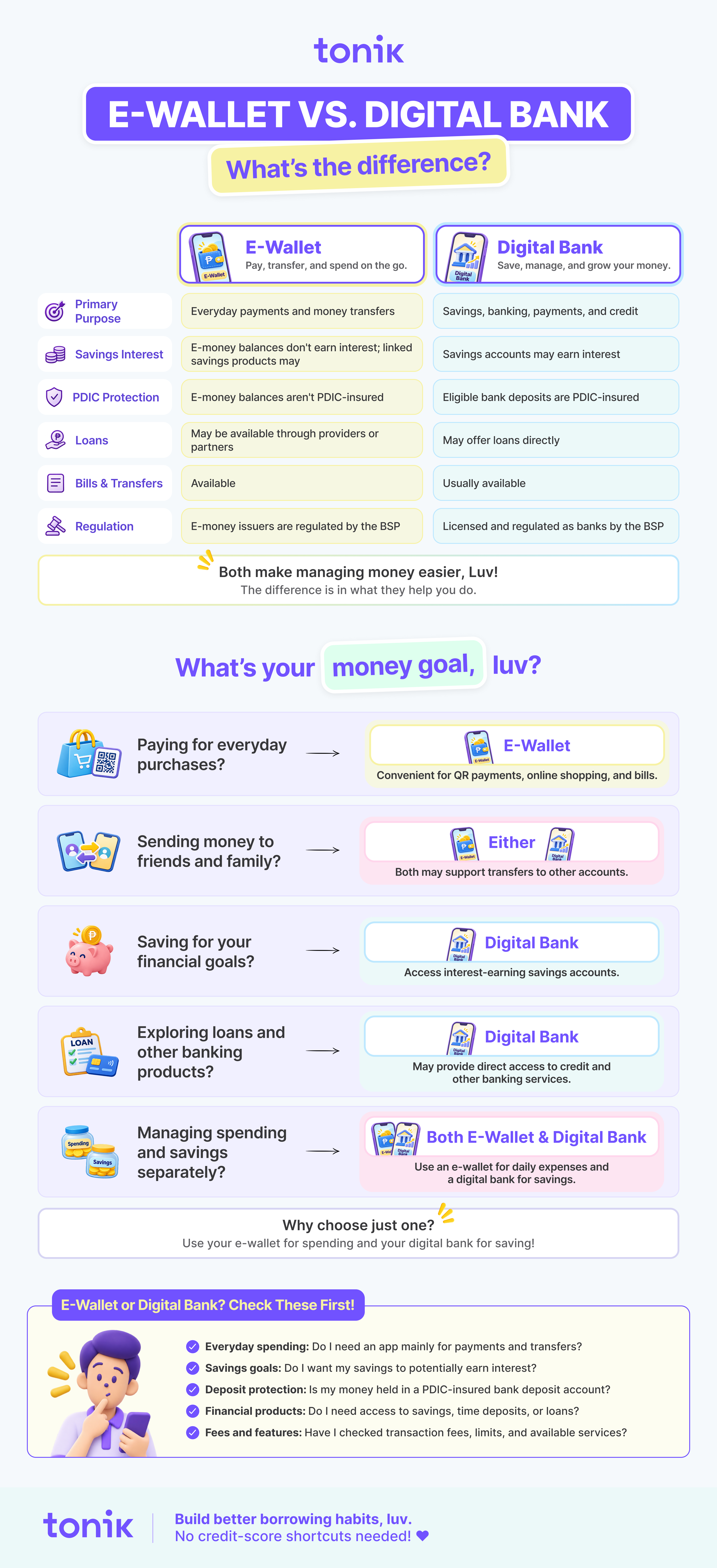
E-Wallet vs. Digital Bank: What's the Main Difference?
Here's the big question: If both let you manage money through an app, what actually sets them apart?
The answer comes down to their primary purpose, financial services, and regulatory classification.
E-wallets are generally designed to make payments and everyday transactions convenient. Digital banks, meanwhile, provide a broader range of banking services, including deposit accounts, savings products, and loans.
To make this e-wallet vs. digital bank comparison easier, here's a quick breakdown of their features:
Feature | E-Wallets | Digital Banks |
|---|---|---|
Primary purpose | Everyday payments and money transfers | Savings, banking, payments, and credit |
Savings interest | E-money balances don't earn interest; linked savings products may | Savings accounts may earn interest |
PDIC protection | E-money balances aren't PDIC-insured | Eligible bank deposits are PDIC-insured |
Loans | May be available through providers or partners | May offer loans directly |
Bills and transfers | Yes | Usually available |
Physical branches | Generally not needed | No physical banking branches |
Regulation | E-money issuers are regulated by the BSP | Licensed and regulated as banks by the BSP |
What About Safety?
Another important consideration when comparing an e-wallet vs. digital bank is safety.
Both e-wallets and digital banks operate within BSP regulatory frameworks, but there's an important distinction when it comes to protecting your money.
Under BSP regulations, e-money is not considered a bank deposit, meaning ordinary e-wallet balances don't qualify for PDIC deposit insurance.
What about the safety of digital banks? When you make a deposit, that amount is PDIC insured up to ₱1 million per depositor, per bank, effective March 15, 2025.
E-Wallet vs. Digital Bank: Which Is Best for You?
The good news? You don't necessarily have to choose just one!
Both e-wallets and digital banks offer different advantages, and the right choice depends on how you manage your money.
Choose an E-Wallet If You...
- Frequently make QR payments and online purchases.
- Need a convenient way to send money to friends and family.
- Prefer quick and easy access to funds for daily expenses.
- Want a simple tool for managing everyday transactions.
If your priority is paying bills, buying load, or splitting expenses with your barkada, an e-wallet might be your everyday bestie.
Choose a Digital Bank If You...
- Want to grow your savings through interest-earning accounts.
- Are saving for financial goals like a vacation, emergency fund, or major purchase.
- Need access to banking products like time deposits or loans.
- Prefer managing your finances without visiting a physical bank branch.
If you're looking to build better financial habits and make your money work a little harder, a digital bank could be the perfect match.
Ultimately, the winner of the e-wallet vs. digital bank debate depends on your lifestyle, spending habits, and financial goals.
Why Not Use Both?
Here's a little money-management tip, Luv: Use your e-wallet for spending and your digital bank for saving.
For example, you can keep a set amount in your e-wallet for everyday purchases while setting aside money in a digital bank for your bigger financial goals.
This way, you're separating your spending money from your savings, making it easier to keep track of both.
After all, choosing between an e-wallet vs. digital bank doesn't have to be an either-or decision. Using both can help you get the best of both worlds!
Frequently Asked Questions About E-Wallets and Digital Banks
Is GCash an E-Wallet or a Digital Bank?
GCash is primarily an e-wallet, not a BSP-licensed digital bank. However, its app also provides access to other financial services, including savings products offered by partner banks.
Is Maya an E-Wallet or a Digital Bank?
Both services are available within the Maya ecosystem! Maya's app includes e-wallet services, while Maya Bank is a BSP-licensed digital bank offering banking products such as savings accounts.
The important thing is to check whether your money is held as an e-wallet balance or in an actual bank deposit account.
Can I Transfer Money From an E-Wallet to a Digital Bank?
Yes! Many e-wallets and digital banks support transfers through payment systems such as InstaPay and PESONet, depending on the provider. Just remember to check for applicable transfer fees and transaction limits.
Are Digital Banks Safer Than E-Wallets?
Both are subject to BSP regulations and security requirements. However, eligible deposits with digital banks have an additional layer of protection through PDIC insurance, which doesn't apply to ordinary e-money balances.
Can I Have Both an E-Wallet and a Digital Bank Account?
Absolutely! Using both can help you organize your finances, with an e-wallet for everyday transactions and a digital bank for saving and accessing other banking services.
Conclusion: E-Wallet vs. Digital Bank? You Decide!
At the end of the day, e-wallets and digital banks aren't necessarily competing for your attention. They're simply different tools designed to make managing money easier.
E-wallets make everyday spending convenient, while digital banks can help you save, borrow, and work toward bigger financial goals.
And if you're ready to give your savings a little extra love, why not explore what Tonik Digital Bank has to offer?
From savings accounts to Time Deposits and loan products, Tonik makes banking simple, accessible, and completely digital.
Ready to make smarter money moves, Luv? Try Tonik today!
XOXO,
Tonik 💜