Are Digital Banks in the Philippines PDIC-Insured?
⚡ Quick Take
Yes, Luv. All seven BSP-licensed digital banks in the Philippines are PDIC members, so their deposits are insured on the same terms as a traditional bank's: up to ₱1 million per depositor per bank, the limit in effect since March 15, 2025. That covers Tonik Bank, Maya Bank, GoTyme Bank, UNO Digital Bank, UnionDigital Bank, Overseas Filipino Bank (OFBank) and MariBank. Deposit insurance comes with the bank licence, not the branch network, so a bank that lives in an app is protected the same way as one with a branch on every corner. What matters is whether your money is actually a deposit. E-wallet balances, investment products and anything above ₱1 million at one bank aren't covered, and that's where people get caught out.
Table of Contents
- What PDIC Insurance Covers, and How Much
- Why a Digital Bank Is Insured the Same as a Traditional Bank
- What PDIC Does Not Cover
- What Actually Happens If a Digital Bank Closes
- How to Check Whether a Bank or App Is PDIC-Insured
- How Tonik Bank Deposits Are Covered
- How We Checked This
- FAQ
- Bes, No Branch Doesn't Mean No Protection
What PDIC Insurance Covers, and How Much
The Philippine Deposit Insurance Corporation (PDIC) is the government agency that insures bank deposits. If the Bangko Sentral ng Pilipinas (BSP) orders a bank to close, PDIC pays depositors back up to the maximum deposit insurance coverage, or MDIC. That limit doubled from ₱500,000 to ₱1 million on March 15, 2025 (PDIC). You don't apply for it and you don't pay for it. Every BSP-licensed bank has to be a PDIC member, and the banks pay the premiums.
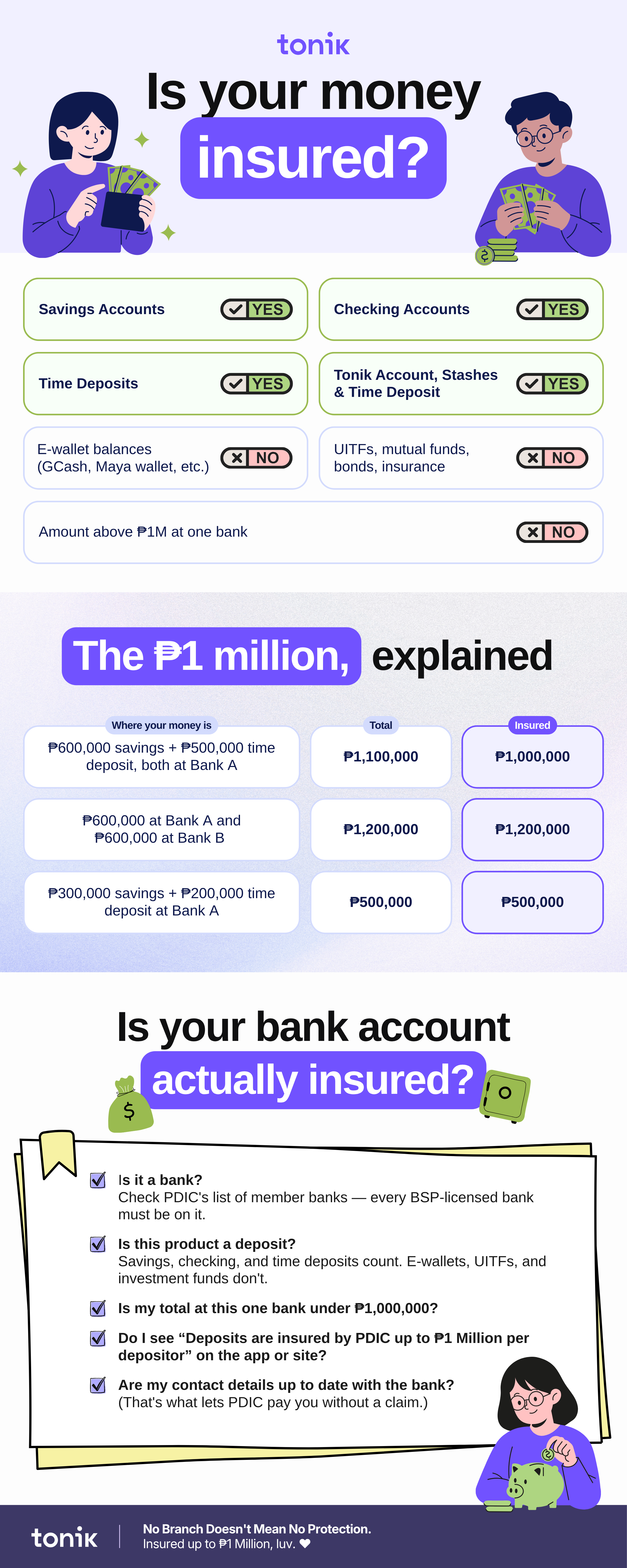
The phrase that trips people up is "per depositor per bank." PDIC adds up everything you have at one bank, across savings, checking and time deposits, and insures the total up to ₱1 million. Opening more accounts at the same bank doesn't raise your limit. Keeping money at a different bank does, because each bank comes with its own ₱1 million.
Where your money is | Total | Insured |
|---|---|---|
₱600,000 savings + ₱500,000 time deposit, both at Bank A | ₱1,100,000 | ₱1,000,000 |
₱600,000 at Bank A and ₱600,000 at Bank B | ₱1,200,000 | ₱1,200,000 (₱600,000 at each) |
₱300,000 savings + ₱200,000 time deposit at Bank A | ₱500,000 | ₱500,000 |
Illustrative examples for one individual depositor with no loans at either bank.
Two details worth knowing. If you owe the closed bank money, PDIC deducts that loan before working out your insured amount. And a joint account's coverage is shared among its co-owners. PDIC's deposit insurance calculator will run the numbers for your own accounts.
Why a Digital Bank Is Insured the Same as a Traditional Bank
Deposit insurance attaches to the bank licence. A digital bank holds a BSP banking licence like any other bank. It just reaches you through an app instead of a branch. Same regulator, same PDIC membership, same ₱1 million coverage. A branchless bank isn't a lesser kind of bank, only a differently built one.
As of November 2026, the BSP has licensed seven digital banks:
- GoTyme Bank
- Maya Bank
- MariBank
- Overseas Filipino Bank (OFBank)
- Tonik Digital Bank
- UNO Digital Bank
- UnionDigital Bank
MariBank is the newest. It converted from a rural bank licence and began operating as a digital bank on July 18, 2026 (GMA News). The BSP caps the number of digital banks at 10, so three licences are still open and this list may grow. PDIC keeps an updated directory of insured digital banks if you want to check it yourself.
What PDIC Does Not Cover
Most articles stop at "yes, it's insured." The part that actually protects you is knowing where coverage ends.
E-wallet balances
This is the big one. Money in an e-wallet isn't a bank deposit. It's e-money, issued by a company the BSP licenses as an electronic money issuer, and PDIC doesn't insure it (Inquirer). It gets confusing because some brands run a wallet and a bank product inside the same app. Your GCash wallet balance is e-money, but GSave is a savings account with CIMB Bank and is insured as a deposit. Maya works the same way: the Maya wallet is e-money, while Maya Savings is held by Maya Bank. Same app, different protection.
Investment and insurance products
Unit investment trust funds (UITFs), mutual funds, bonds, trust accounts and insurance policies aren't deposits, even when a bank sells them to you. Their value can go down, and PDIC doesn't cover them.
Fraudulent or irregular deposits
PDIC also excludes deposits that are unfunded, fictitious or fraudulent, deposit products that come out of unsafe and unsound banking practices, and money found to be proceeds of unlawful activity under the Anti-Money Laundering Act. Regular depositors rarely run into this, but it's why PDIC validates every claim before paying it.
Anything above ₱1 million at one bank
The excess isn't automatically lost, but it isn't insured either. You'd have to claim it against the closed bank's remaining assets during liquidation, with no guarantee of getting all of it back.
What Actually Happens If a Digital Bank Closes
Nobody likes thinking about this part, but the process is clear, and knowing it beats wondering.
- The BSP orders the closure. The Monetary Board orders the bank closed, and PDIC takes over as receiver.
- PDIC announces the payout. It publishes the claims schedule and filing instructions on its website and official channels.
- Many depositors don't need to file anything. PDIC waives claim filing for valid deposits of ₱500,000 and below, as long as you have no loans with the bank, aren't a co-maker on a loan there or the spouse of a borrower, and your details in the bank's records are complete (BusinessWorld).
- Everyone else files with PDIC, not the bank. You have two years from PDIC's takeover to file a deposit insurance claim.
- Amounts above ₱1 million go to liquidation. That part becomes a claim against the bank's assets.
PDIC has been quick about it lately. For the two banks it took over in 2025, payments went out within 10 to 13 working days of the takeover (Manila Bulletin). Payment options now include bank and electronic transfers too. The simplest thing you can do today is keep your contact details up to date with your bank, since that's what decides whether PDIC can pay you without a claim.
How to Check Whether a Bank or App Is PDIC-Insured
Two questions settle it.
- Is it a bank? Look up the institution in PDIC's list of member banks. Every BSP-licensed bank must be a PDIC member, and banks have to show the line "Deposits are insured by PDIC up to ₱1 Million per depositor" on their sites, apps and branches.
- Is this product a deposit? A savings account, checking account or time deposit at a bank is a deposit. An e-wallet balance, a UITF or an investment fund is not, even if you opened it inside a bank's app.
Yes to both means your money is insured up to ₱1 million at that bank. A no to either means it isn't, however polished the app looks.
How Tonik Bank Deposits Are Covered
Tonik Digital Bank, Inc. is a BSP-licensed digital bank and a PDIC member. Your deposits are insured up to ₱1 million, and that limit covers all your Tonik deposit products combined: the Tonik Account, Solo Stash, Group Stash and Time Deposit.
Here's how that plays out. Say you have ₱400,000 in Time Deposits and ₱300,000 across your Stashes. All ₱700,000 is covered, because the total sits under the limit. If your combined balance ever goes past ₱1 million, the amount above it isn't insured, and keeping the extra at another bank is how you stay fully covered.
Coverage is automatic and costs you nothing. And because Tonik is a bank, not an e-wallet, the money in your Tonik Account is a deposit and is insured on exactly those terms. You can read more about who we are and how we're regulated on our About Us page.
How We Checked This
Coverage limits, exclusions and the claims process come from PDIC's published rules and announcements. The list of digital banks reflects BSP licences as of November 2026. PDIC and the BSP update these from time to time, so check PDIC's website for the latest.
Tonik Digital Bank, Inc. is supervised by the Bangko Sentral ng Pilipinas. Deposits are insured by PDIC up to ₱1 Million per depositor.
FAQ
Are digital banks in the Philippines PDIC-insured?
Yes. All seven BSP-licensed digital banks are PDIC members, and deposits with them are insured up to ₱1 million per depositor per bank, the same as at a traditional bank.
How much of my savings is insured by PDIC?
Up to ₱1 million per bank. PDIC adds up all your deposit accounts at that bank and deducts any loans you owe it. Deposits at a different bank are insured separately, with their own ₱1 million limit.
Is my GCash or e-wallet balance PDIC-insured?
No. An e-wallet balance is e-money, not a bank deposit, so PDIC doesn't cover it. Bank savings products you open inside the app are different. GSave, for example, is a CIMB Bank deposit and is insured.
What happens to my money if a digital bank closes?
PDIC takes over and pays insured deposits up to ₱1 million per depositor. If your valid balance is ₱500,000 or less, you have no loans with the bank, and your records are complete, you may not need to file a claim at all. Otherwise, you file with PDIC within two years of the takeover.
Does the ₱1 million limit apply per account or per person?
Per person, per bank. Several accounts at the same bank share one ₱1 million limit. Accounts at different banks each get their own.
Bes, No Branch Doesn't Mean No Protection
A bank that lives on your phone is still a bank, Luv. If it's BSP-licensed and your money sits in a deposit account, PDIC has your back up to ₱1 million. Keep your savings in actual deposits, watch the limit if you're saving big, and remember the one line worth memorizing: wallets aren't deposits.
Tonik is a BSP-licensed digital bank, and every peso in your Tonik Account, Stashes and Time Deposits is insured by PDIC up to ₱1 million per depositor. Open an account in the app with one valid ID, no branch visit needed, then start saving in a Solo Stash or lock in a Tonik Time Deposit.
Now you know exactly what's covered, Luv. Save smart, save safe, and enjoy the kilig of watching it grow.
XOXO,
Tonik 💜