5 Life-Changing Things I Discovered with Digital Banks
For the longest time, I thought banking was pretty straightforward: money goes in, money comes out, and hopefully there's still something left before the next payday. 😅
So, when digital banks started popping up everywhere, my first thought was: Okay… isn't this basically just regular banking on an app?
Turns out, not quite.
After learning more about them, I realized why I switched to a digital bank goes way beyond being able to check my balance without leaving the couch. Digital banking actually changed the way I think about saving, spending, borrowing, and managing my money.
But before I get into the good stuff, let's start with one important question.
Table of Contents
- What Is a Digital Bank, Anyway?
- 1. My Money Could Actually Earn While It Was Sitting There
- 2. My Bank Basically Moved Into My Pocket
- 3. Payments and Money Transfers Stopped Feeling Like a Whole Event
- 4. I Finally Started Seeing Where My Money Was Actually Going
- 5. I Learned That Building Credit Is Something I Can Actually Work On
- So, Are Digital Banks Really Worth the Hype?
What Is a Digital Bank, Anyway?
A digital bank isn't simply a traditional bank with a mobile app.
In the Philippines, the Bangko Sentral ng Pilipinas (BSP) defines a digital bank as a bank that offers financial products and services that are processed end-to-end through digital platforms or electronic channels, without physical branches offering those banking services.
That "end-to-end" part is important.
With a traditional bank, you may be able to transfer money, pay bills, or check your account through an app, but some services may still involve branches or other offline processes. A digital bank is designed around the idea that your banking journey can happen digitally from beginning to end.
And yes, digital banks are still banks. They are a distinct bank classification regulated by the BSP. Eligible deposits in PDIC-member banks are also insured up to ₱1 million per depositor, per bank, effective March 15, 2025.
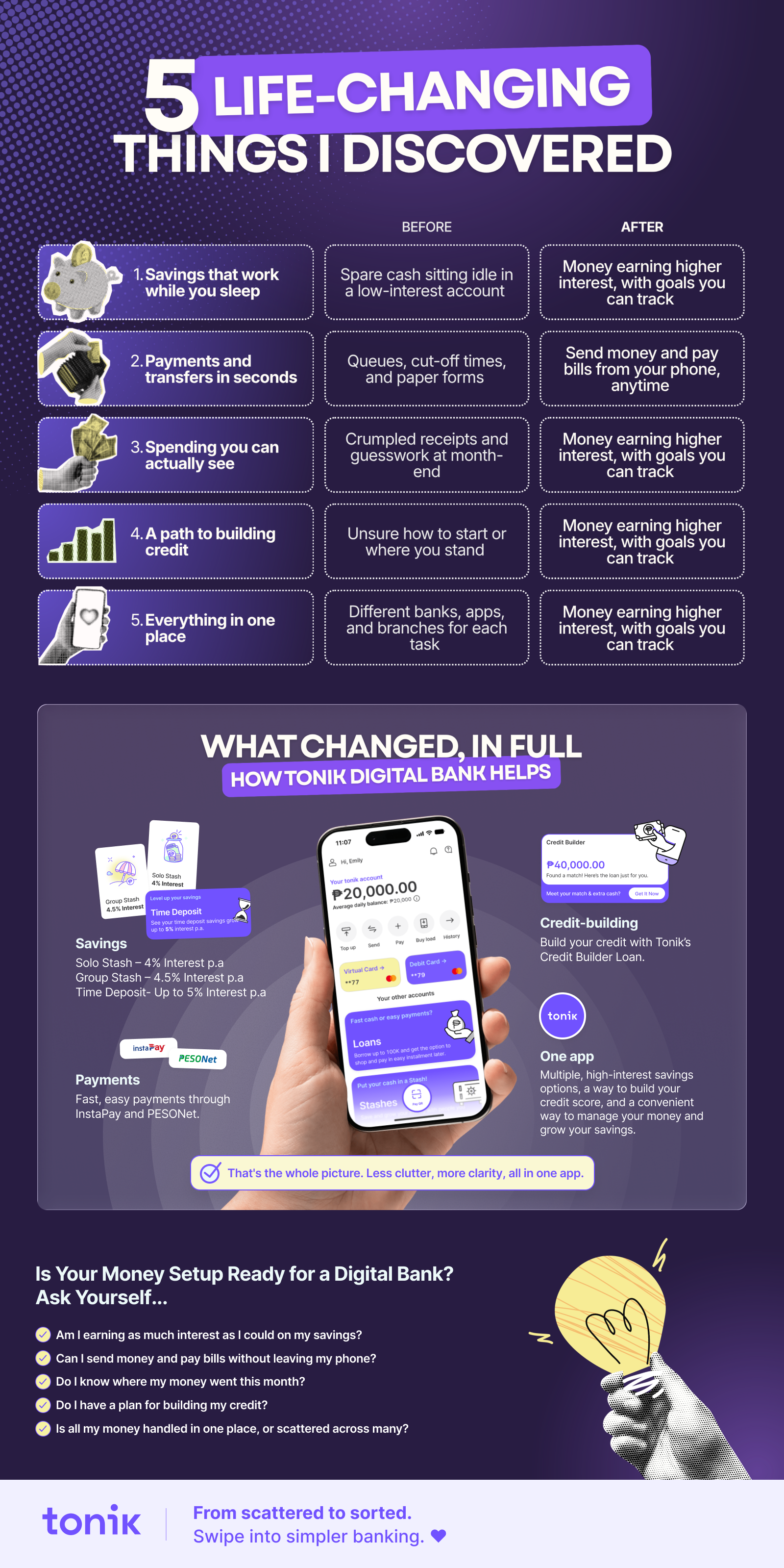
Now that we have that sorted, here are the five things that made me understand why I switched to a digital bank.
1. My money could actually earn while it was sitting there
Here is probably my biggest discovery: money doesn't necessarily have to sit around doing absolutely nothing.
Before getting into digital banking, I thought of a savings account mostly as a safe place to keep money I wasn't planning to spend yet. Put money in. Leave it there. Repeat.
Digital banks made me pay a lot more attention to interest rates.
Some digital banks offer savings products that allow your deposits to earn interest while you work toward your goals.
Time deposits are one example. Many digital banks offer this feature, which is a place where users can lock away a certain amount of money over a certain time period. After locking it away, you typically get the amount back with interest. More power to your money!
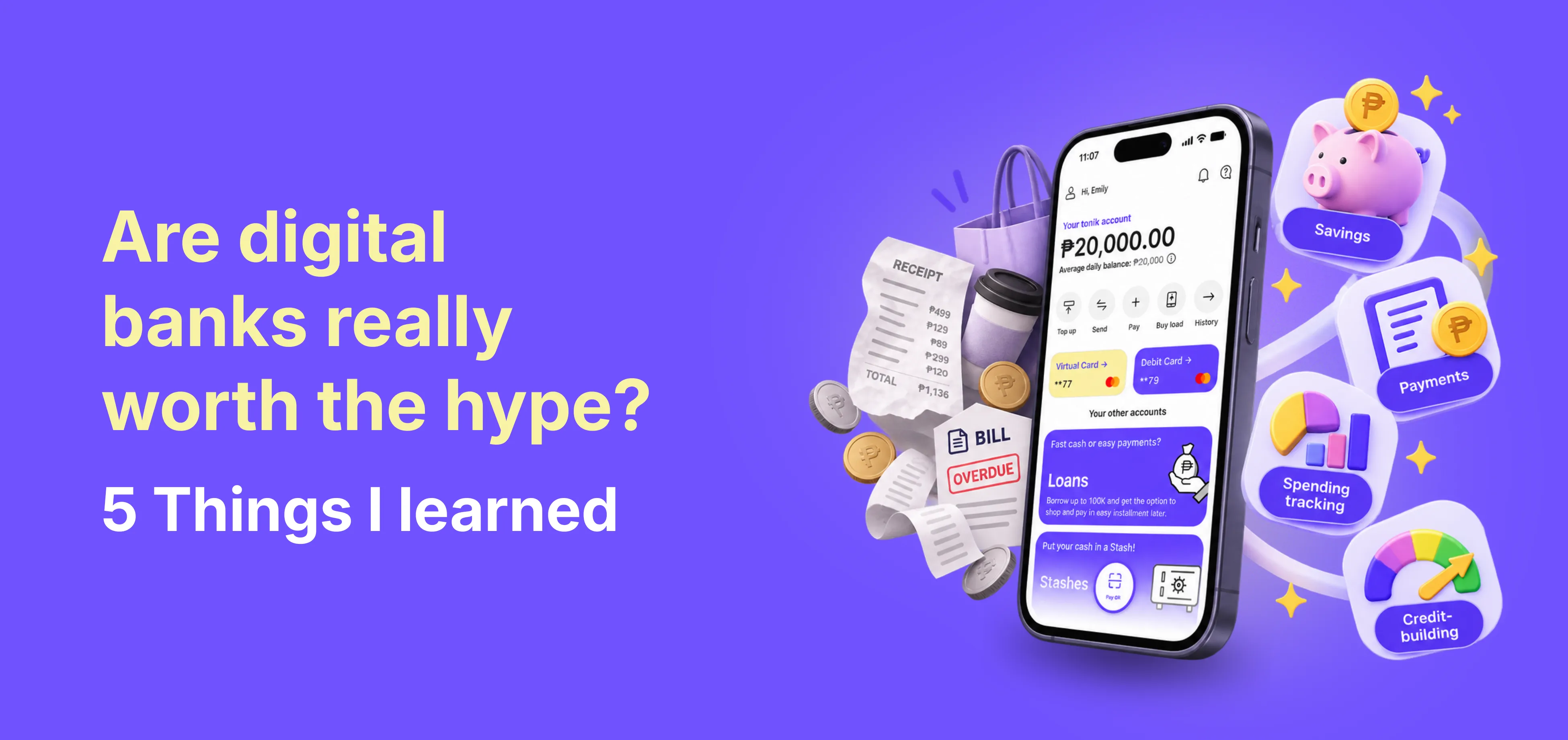
Ever wanted a place to put your money and make it earn for you without locking it away? At Tonik, you can separate money into Stashes for different savings goals while still earning interest. Think emergency fund, dream vacation, new laptop, Christmas budget, or that one purchase you've been telling yourself you definitely need. 😉 Tonik lets customers create both Solo and Group Stashes, depending on whether they want to save independently or toward a goal with other people.
That was one major reason why I switched to a digital bank: I started asking not just "How much money do I have?" but also "What is my money doing for me?"
Very different question, luv.
2. My bank basically moved into my pocket
Okay, this one sounds obvious, but I didn't realize just how much it would change my relationship with banking.
Need to check my balance? Phone.
Want to move money into savings? Phone.
Need to transfer funds? Yep, still my phone.
Instead of treating banking as something I had to make time for, it started fitting around everything else I was already doing.
And that convenience matters more than I initially thought.
When accessing your account is easier, little money tasks can become easier to manage too. Moving part of your salary into savings doesn't have to become a "when I have time" problem. Checking whether you can actually afford that spontaneous purchase takes a few seconds.
It's one of the simplest reasons why I switched to a digital bank, but also one of the most practical: managing my money started feeling less like an errand.
No branch hopping. No "I'll do it next week." Just open the app and get it sorted.
Looking back, why I switched to a digital bank had a lot to do with realizing that banking could fit into my everyday routine instead of the other way around.
3. Payments and money transfers stopped feeling like a whole event
Remember when sending money sometimes meant figuring out where the nearest branch or payment center was?
Digital banking has helped make everyday transactions much quicker.
Depending on the bank and service available, users can send funds electronically, receive money, pay for purchases, settle bills, and perform other transactions directly through digital channels.
Tonik, for example, supports electronic fund transfers through InstaPay and PESONet.
And while saving a few minutes here and there might not sound "life-changing," those little moments add up.
Paying somebody back immediately instead of telling them, "Wait, I'll send it later."
Transferring money to your savings before you accidentally spend it.
Taking care of a payment while you're having your morning coffee.
It made me realize that good money management isn't always about making one huge financial decision. Sometimes, it's about removing enough friction that doing the responsible thing becomes easier.
And that became another part of why I switched to a digital bank.
4. I finally started seeing where my money was actually going
There is a very specific kind of fear that comes with looking at your transaction history after a particularly expensive weekend.
Surely I did not spend that much.
Narrator: I did. 😭
But seeing my transactions more clearly ended up being one of the best things that happened to my budgeting habits.
Having easy access to account activity meant I could look back at how I was spending instead of relying on the very unreliable system known as "I think I still have enough."
A ₱150 purchase here and a ₱300 purchase there might not feel huge at the time. But when you see several of them together, patterns start becoming much easier to spot.
Maybe it's food deliveries.
Maybe it's online shopping.
Maybe it's subscriptions you forgot you even had.
And once I could see those habits more clearly, budgeting stopped being about randomly telling myself to spend less.
Instead, I could ask better questions:
- Where is most of my money actually going?
- Which expenses are important to me?
- What can I realistically cut back on?
- How much can I put toward savings before I start spending?
That increased visibility is another reason why I switched to a digital bank. The app wasn't magically budgeting for me—I still had to make the decisions—but having my financial activity easily accessible gave me better information to make them.
And sometimes, luv, seeing the receipts is exactly the reality check we need.
5. I learned that building credit is something I can actually work on
Before this, "credit history" sounded like one of those very adult financial concepts I was supposed to understand but somehow never learned in school.
But your borrowing and repayment behavior can matter when lenders assess you.
The Credit Information Corporation (CIC) explains that credit reports can include information such as timely loan repayments and defaults. It also recommends paying loans on time and in full as one way to build a good credit history.
That changed how I looked at loans.
Borrowing isn't just about getting money today. How responsibly you handle credit can become part of your financial track record.
Some digital banking products are designed with that journey in mind. Tonik's Credit Builder, for example, is intended for customers with limited credit history or lower credit scores and allows eligible borrowers to start with a smaller loan while building their credit relationship with the bank.
Of course, taking out a loan just for the sake of having one isn't the goal. Any borrowing decision should still be based on what you actually need, what you can afford, and whether you can make the repayments on time.
But understanding how credit works helped make it feel much less intimidating.
Instead of thinking of credit as something that simply happens to me, I learned that responsible borrowing and repayment are financial habits I can actively manage.
This became another unexpected part of why I switched to a digital bank: I wasn't only getting access to financial products—I was also learning more about how credit works and how my own habits can affect my financial journey.
And honestly? That might be one of the most unexpected things I discovered.
So, are digital banks really worth the hype?
For me, the biggest surprise wasn't simply that digital banking made things faster.
Yes, doing things from my phone is convenient. Quick payments are great. And not having to rearrange my day around a trip to a branch? Absolutely appreciated.
But why I switched to a digital bank really comes down to something bigger.
It changed how involved I was with my own money.
I started paying attention to interest rates instead of letting savings sit unnoticed. I became more conscious of my spending. I started separating money according to my goals. And I finally understood that things like credit history aren't just financial jargon—they can influence the financial opportunities available to me later on.
Digital banks won't magically fix your finances. You still have to save, budget, spend responsibly, and make smart borrowing decisions.
But having the right financial tools at your fingertips can make those habits a whole lot easier to start.
And if you're going to be in a relationship with your money for the rest of your life, luv, you might as well make it a good one. 💜