How Revolving Credit Affects Your Credit Score in the Philippines
⚡ Quick Take
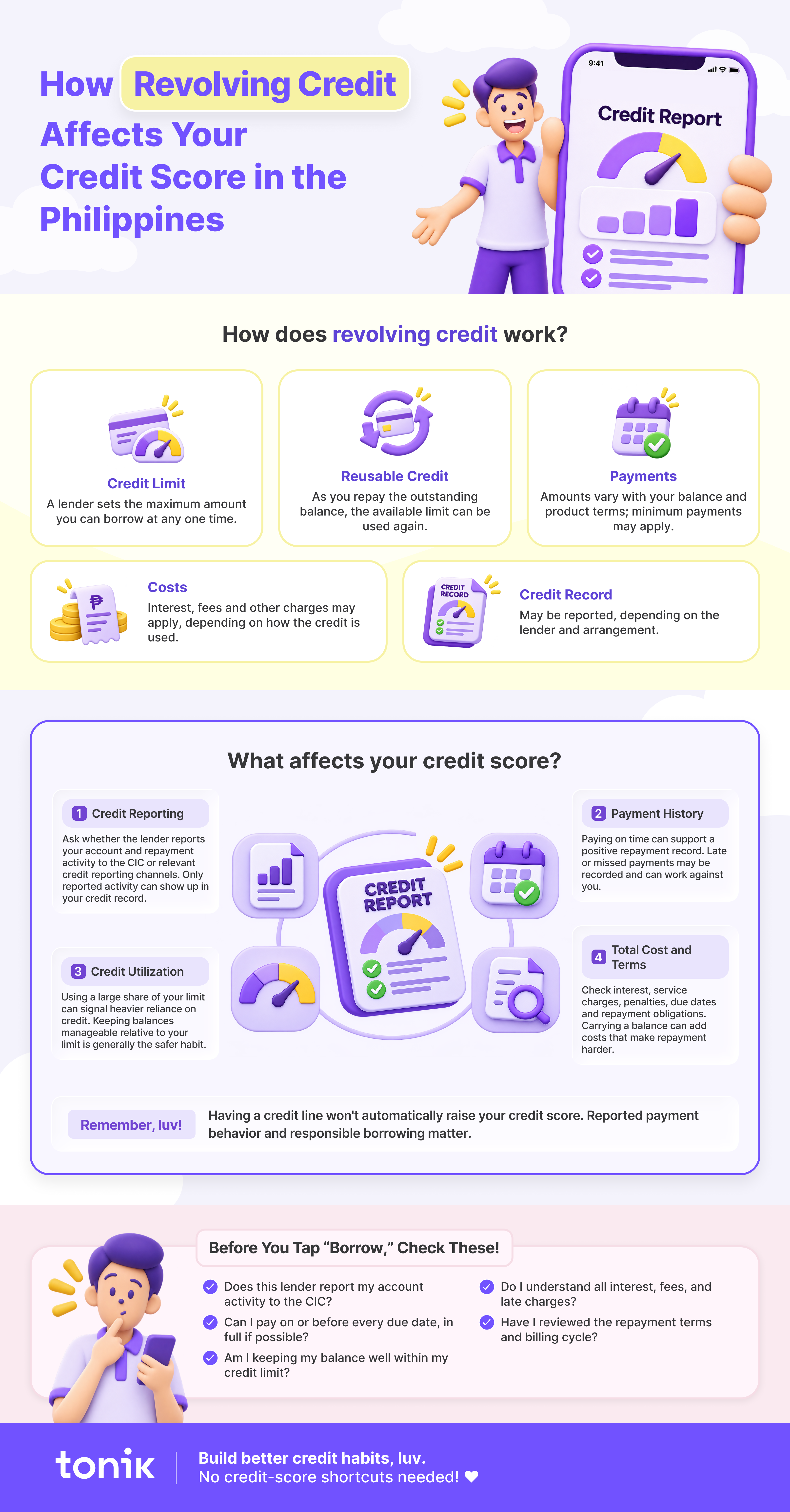
Revolving credit shapes your credit score mainly through two things: your payment history (paying on time is the biggest single factor) and your credit utilization ratio (how much of your limit you're using). Pay on time and keep your balance low, and revolving credit becomes one of the best tools for building a strong credit profile in the Philippines.
Table of Contents
- Why your credit score matters more than ever
- The two big ways revolving credit moves your score
- Payment history: the foundation of your credit profile
- Credit utilization: the number you need to watch
- Other Ways revolving credit shapes your profile
- Common mistakes that hurt your score
- Tonik and credit inclusion
- Frequently Asked Questions
- The bottom line
Why your credit score matters more than ever
Luv, here's something a lot of Filipinos don't know: there's a government agency keeping a record of how you borrow.
It's called the Credit Information Corporation (CIC), created under the Credit Information System Act (RA 9510). Banks, financing companies, credit card issuers, and other lenders send it your credit data, both the good and the bad. Accredited credit bureaus like CIBI, CRIF Philippines, and TransUnion Philippines then use that data to calculate your credit score.
Why should you care? Because regulated lenders can check that record whenever you apply for a loan, a credit card, or a higher limit. Your score helps decide whether you're approved, how much you can borrow, and sometimes what rate you pay. If credit scoring still feels mysterious, start with the truth about credit scoring in the Philippines.
The two big ways revolving credit moves your score
TransUnion Philippines weighs five factors in its credit score. Revolving credit, like a credit card or credit line, touches all five. But two of them carry most of the weight:
Factor | Approximate weight |
|---|---|
Payment history | 35% |
Credit utilization | 30% |
Length of credit history | 15% |
Credit mix | 10% |
Recent credit applications | 10% |
Payment history and utilization together make up about 65% of the score. Get those two right and you're most of the way there.
Payment history: the foundation of your credit profile
Every time your lender reports your account to the CIC, it shows whether you paid on time. On-time payments build your record month by month. Late or missed payments go on it too.
And a missed payment can stick around. Under the rules implementing RA 9510, negative information can stay in the CIC database for up to three years after you've settled it. If you never settle it, it doesn't simply disappear after three years. Grabe, right? One forgotten due date can follow you for a long time.
The flip side is the good news. Lenders love consistency. Twelve straight months of on-time payments tell a much clearer story than a single big loan you paid off once. That's what makes revolving credit so useful: every billing cycle is another chance to add a clean entry.
Not a calendar person? Set up autopay or phone reminders. Here are more loan repayment strategies to keep you on track.
Credit utilization: the number you need to watch
Your credit utilization ratio is how much of your revolving credit you're using:
Utilization = amount owed ÷ credit limit × 100
Owe ₱6,000 on a ₱20,000 limit? That's 30%.
The 30% rule of thumb
Lenders generally like to see utilization below 30%. Some guides suggest staying under 10% for the strongest scores. Think of 30% as a guardrail, not a magic number. Lower is generally better, but using a small amount and paying it off is better than never using your line at all.
High utilization is a warning sign, even if you pay on time
This surprises people. You can pay every bill on time and still lose points if your balance is always close to your limit. To a lender, a maxed-out line can look like you depend on credit to get by, and that's a risk signal on its own.
The mid-cycle payment trick
Your lender usually reports your balance around your statement date. So the balance on that date is the one that matters most for utilization.
Say you have a ₱20,000 limit and spend ₱12,000 this cycle. That's 60% utilization if the statement closes today. Pay ₱8,000 before your statement date, and the reported balance drops to ₱4,000, or 20%. You spent the same amount, but your utilization went from 60% to 20%. Pak na pak. 💜
Other ways revolving credit shapes your profile
Credit age. The longer your accounts have been open with a clean record, the better. A revolving line can stay open for years, so it quietly builds your credit age just by being there and staying in good standing.
Credit mix. Lenders like to see that you can handle different kinds of credit. Having an installment loan (fixed payments, fixed end date) alongside a revolving line shows you can manage both. (BNPL plans count as installment credit, which is why they don't build utilization history. Here's how BNPL compares with revolving credit.) Here's more on how different types of credit accounts shape your score.
Hard inquiries. When you apply for new credit, the lender checks your record, and that check can lower your score a little. A few applications spread out over time are normal. Lots of applications in a short window can make you look desperate for credit.
Common mistakes that hurt your score
Maxing out your limit every month. Even if you pay it all off later, a balance near your limit at statement time pushes your utilization up. Pay down before the statement date, or ask for a limit increase (and then don't spend it).
Treating the minimum payment as "fine." Paying the minimum on time does count as an on-time payment, so it protects your payment history. But the rest of your balance keeps collecting interest and keeps your utilization high. Pay more than the minimum whenever you can.
Closing old accounts. Closing your oldest line can shorten your credit history and shrink your total available credit. That pushes your utilization up overnight. If an old account has no annual fee, keeping it open and lightly used is often the smarter move.
Opening many new accounts at once. Each application can add a hard inquiry, and a bunch of new accounts lowers the average age of your credit. Apply for what you need, when you need it.
Revolving credit as a credit-building tool
If you have no credit history at all, you're "thin-file." To lenders, you're not a bad borrower, just an unknown one. A revolving account managed well is one of the fastest ways to fix that, because it builds positive history every single month.
It compounds, too. One on-time cycle is a small entry. Twelve cycles is a year-long record. Twenty-four cycles, with low utilization and an account that keeps getting older, is the kind of profile that opens doors to bigger limits and better rates. Want the full rundown? Read our guide on how to build and maintain good credit.
Tonik and credit inclusion
Most Filipinos have never had the chance to build a formal credit record. Tonik estimates that 90% of Filipinos aren't served by formal bank lenders. Tonik was built to be the starting point for exactly those people.
That's why Tonik doesn't depend on a traditional credit score to get you started. Its AI-driven credit scoring models look beyond bureau data, using signals like payment behavior to assess borrowers with no formal credit history. According to Tonik's Group CTO, more than four in five Tonik borrowers are getting formal credit for the first time.
Once you're in, every repayment adds to your track record. The Credit Builder Loan is built for exactly this: borrow up to ₱50,000 over 6, 9, or 12 months, with your payments reported to credit bureaus. That history becomes the foundation for more access later.
And here's what's coming. Tonik has named revolving credit products for repeat borrowers as a near-term priority. For you, that could mean a credit line that stays open and grows with you, instead of starting from scratch every time. Every on-time payment would keep building your score.
Start your credit journey with Tonik. Download the Tonik app and explore our loans. Your future self will thank you. 💜
Frequently Asked Questions
Does checking my own credit score affect it?
No. Requesting your own credit report or score isn't a credit application, so it doesn't count as a hard inquiry. Hard inquiries come from lenders checking your record when you apply for credit. Checking your own regularly is a good habit, since it helps you catch errors early. Here's how to check your credit score in the Philippines.
How long does a missed payment stay on my CIC record?
Negative information can stay in the CIC database for up to three years after it's been rectified, meaning paid, settled, or cleared by a court. The clock starts when you settle, not when you first missed the payment. That's why it pays to settle overdue accounts as soon as you can. If you're working through a bad record, our guide on how to clear a bad credit history can help.
Can revolving credit hurt my score even if I pay on time?
Yes. High utilization can drag your score down even with a perfect payment record. Applying for lots of new accounts at once, or closing your oldest one, can also hurt. On-time payments are the foundation, but your balances matter too.
How soon does my credit score improve after paying down revolving debt?
Utilization changes can show up fairly quickly, often after your lender's next report to the CIC, which is usually tied to your billing cycle. Payment history improves more slowly because it builds with every on-time month. Be patient and consistent, and the numbers will follow.
The bottom line
Revolving credit moves your score in two big ways: whether you pay on time, and how much of your limit you use. Get those right, keep your oldest accounts healthy, and don't apply for everything at once. Each on-time cycle adds to a record that keeps getting stronger. You've got this, Luv.
XOXO,
Tonik 💜