Hidden Fees on Online Loans in the Philippines: 7 to Check
Quick Take
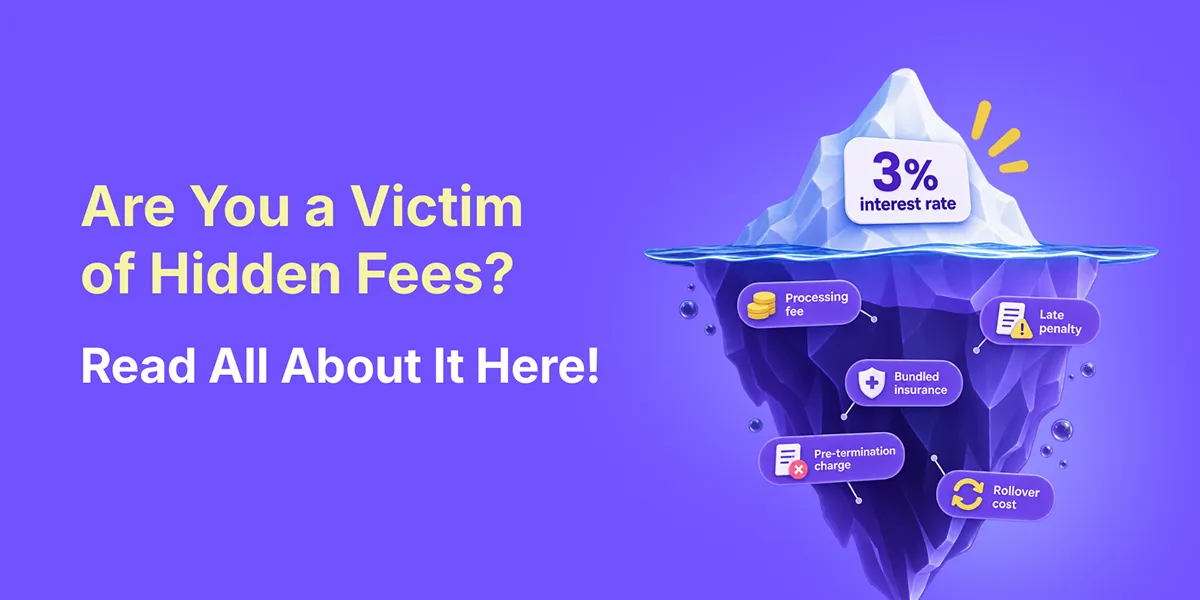
Here's the tea: that advertised interest rate you've been comparing isn't the real price tag. The actual cost hides in the processing fee, whether it's add-on or diminishing interest, late penalties, pre-termination charges, and bundled insurance you didn't ask for — the full menu of hidden fees online loans Philippines borrowers run into every day.
The good news — Philippine law says lenders have to hand you the real number, the effective interest rate, in writing, before you sign anything. So skip the headline rate and go straight for the total amount payable. That's the number that actually matters.
Table of Contents
Why the Advertised Rate Isn't the Price
Quick game: two lenders offer you a loan. Lender A says 3% interest. Lender B says 4.20%. Lender A wins, right? Not so fast. That headline number is just one ingredient in a much bigger recipe — and the other ingredients (fees, penalties, add-ons) can quietly make Lender A's loan cost more in the end.
This is where the effective interest rate (EIR) comes in clutch. Think of it as the no-funny-business version of the interest rate — it bundles in every fee tied to borrowing and spits out one number you can actually compare apples to apples. Under the Truth in Lending Act (RA 3765), lenders are legally required to hand you this number before you sign, precisely so you're not left doing detective work on your own.
Moral of the story: stop shopping by the sticker rate. Shop by the total amount payable and the EIR on the disclosure statement. Everything below is your cheat sheet for finding the hidden fees online loans Philippines lenders don't lead with.
The Seven Charges to Check on Any Loan Offer
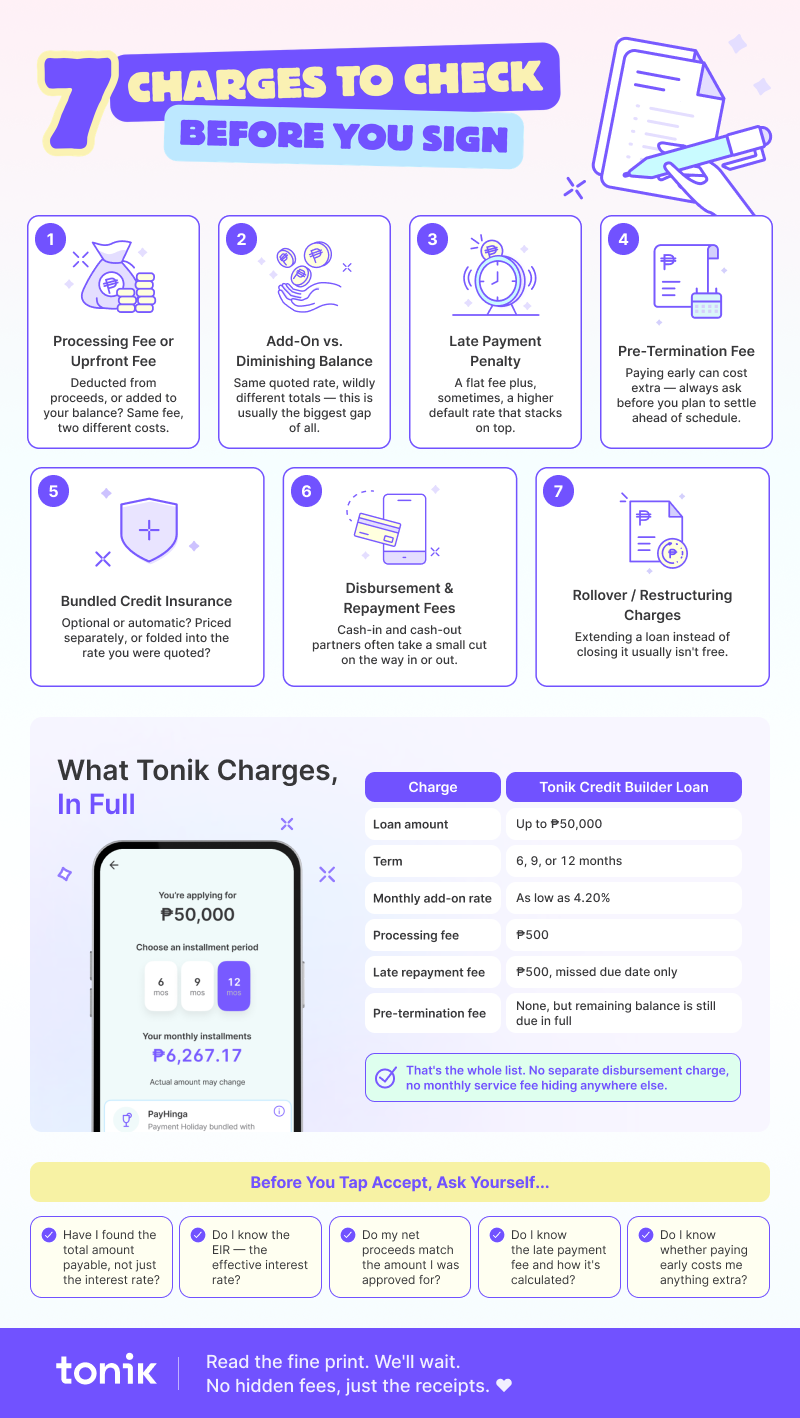
Before you tap "Accept" on any loan offer, run it through this checklist. It covers the exact hidden fees online loans Philippines borrowers keep getting blindsided by — and the one question to ask about each.
1. Processing or Upfront Fee
Nearly every loan comes with some version of a processing fee — sometimes flat, sometimes a percentage of what you're borrowing. Here's the plot twist that actually matters: is it deducted from your proceeds, or added to your balance? Deduct it, and you get less cash in hand than you're technically borrowing — yes, that means paying interest on money you never even touched. Add it to your balance instead, and you get the full amount, but your total repayment climbs. Same ₱1,000 fee, two very different outcomes. That's the whole story behind any processing fee loan Philippines question: ask your lender straight up, is this fee coming out of what I get, or added to what I owe?
2. Add-On Interest Versus Diminishing Balance
This is the one that trips up almost everyone, and it's the single biggest number in this entire article. So, what is add-on interest rate, exactly, and how is it different from the alternative? Add-on interest is calculated once, on your full original loan amount, for the entire term — even as you're paying it down. Diminishing balance interest recalculates every month based on what you actually still owe, so the interest shrinks along with your balance.
Here's the math nobody shows you: borrow ₱30,000 at 3% a month for 12 months. Under add-on interest, you're charged 3% of the full ₱30,000 every single month, no matter how much you've already repaid — ₱10,800 in total interest, bringing your total repayment to ₱40,800. Under diminishing balance at the exact same 3% rate, you'd pay roughly ₱6,169 in total interest instead. Same quoted rate, over ₱4,600 apart. If a lender only says "3% monthly" without telling you which method applies, that's your cue to ask — loudly.
3. Late Payment Penalty and Default Interest
Miss a due date, and you could be looking at two separate charges: a flat late fee, plus, in some cases, a higher default interest rate on the overdue amount until you settle it. These can stack, so a short delay can cost more than the penalty fee alone suggests — a classic entry on any list of hidden fees online loans Philippines borrowers only discover after the fact. For the smallest loans in the market — unsecured, ₱10,000 or less, with four-month terms or shorter — regulators actually cap this for loans offered by financing companies, lending companies, and online lending platforms: SEC Memorandum Circular No. 3, s. 2022 sets the penalty ceiling at 5% per month. Outside that specific bracket, it's largely the lender's choice, so always check the peso amount or percentage for a missed payment, and whether interest keeps piling up on top.
4. Pre-Termination or Early Settlement Fee
Yes, you read that right — paying off your loan early can sometimes cost you extra. Some lenders charge a pre-termination fee, basically compensation for the interest income they lose when you close a loan ahead of schedule. Any pre-termination fee loan Philippines borrowers should watch for is easy to miss, because it only becomes relevant much later, well after you've signed. If there's a chance you might pay off a loan early — bonus season, maybe — ask upfront whether an early settlement fee applies and how it's calculated. A genuine zero pre-termination fee is a good sign, so give credit where it's due.
5. Bundled Credit Insurance
Some loans quietly come bundled with a credit life or credit insurance add-on, meant to cover your balance if something happens to you — another classic on the hidden fees online loans Philippines watchlist. Two questions settle this fast: is it optional, and is its cost already folded into the EIR you were quoted, or charged separately on top? An add-on you can decline is a very different deal from one baked silently into a price you can't see. If insurance is offered, ask for its cost as its own peso figure, not just a mention buried in the terms. Make sure they inform you which insurance provider it is too, luv!
6. Disbursement and Repayment Channel Fees
Getting the loan is one thing — moving the money is another, and that can cost something too. Over-the-counter cash-in and cash-out partners often charge a small handling fee, and some e-wallet channels do the same coming or going. These are the quieter hidden fees online loans Philippines lenders rarely spell out upfront. On top of that, you could also incur repayment fees. Individually they look tiny, but they recur every time you fund a payment, and they rarely make it into the headline comparison. Ask which repayment channels are fee-free.
7. Rollover, Renewal, and Restructuring Charges
Extending or restructuring a loan instead of paying it off on schedule? That flexibility usually isn't free. Rollover fees, renewal charges, or restructuring costs can apply, sometimes alongside a fresh processing fee as if the loan were brand new — rounding out our list of hidden fees online loans Philippines to watch for. This one bites hardest on short-term loans that are easy to keep extending instead of closing out. Before agreeing to any rollover or restructuring offer, ask for the total cost in pesos — not just the new due date.
What Philippine Law Requires Lenders to Disclose
Two different regulators handle fee disclosure in the Philippines, and knowing which one applies to your lender tells you what protections you actually have.
The Truth in Lending Act (RA 3765) is the law that started it all: any lender extending credit has to disclose the cash price, the finance charges, and the effective interest rate, in writing, before you sign anything. BSP Circular No. 730 leveled this up specifically for banks, standardizing the disclosure format and requiring EIR to be calculated properly, using discounted cash flow methodology rather than a simplified shortcut that flatters the lender.
Lending companies, financing companies, and their online lending platforms answer to a different regulator entirely — the Securities and Exchange Commission (SEC), except in the few instances that these companies also hold BSP licenses. For a very specific slice of the market — unsecured, general-purpose loans of ₱10,000 or less with terms of four months or less — SEC Memorandum Circular No. 3, s. 2022 sets hard limits: 6% nominal interest per month, 15% EIR per month, 5% penalty per month, and a total cost that can never exceed 100% of what you borrowed.
Here's why this matters: a BSP-licensed digital bank plays by banking rules, not SEC lending-company rules. Same industry, different playbook — so don't assume a cap or protection automatically applies just because two loans look similar on the surface. Always check which regulator actually oversees your lender. That single fact is key to understanding which hidden fees online loans Philippines regulations actually cover, and which they don't.
How to Read a Disclosure Statement in Two Minutes
Every licensed lender has to hand you a disclosure statement before you accept a loan. Most people barely glance at it. Here's how to check loan fees Philippines lenders are required to disclose — in two minutes, checking these five things, in order:
- Find the total amount payable. This is the true bottom line — principal plus every fee, charge, and interest payment over the life of the loan. It's the single number that lets you compare offers fairly.
- Find the effective interest rate (EIR). It should be stated in plain sight, not buried in a footnote. If you can't find it, ask directly — it's a required disclosure, not a bonus.
- Find the net proceeds and compare them to your approved amount. A mismatch usually means an upfront fee got deducted before the money even reached you.
- Find the late payment fee and how it's calculated — flat peso amount, percentage, or both.
- Find the pre-termination clause and confirm whether paying early costs you anything extra.
Do this before you tap "accept," not after. A disclosure statement you've actually read is the fastest way to know exactly what you're signing up for — and honestly, the only version of "hidden fees" that should exist is the one you didn't bother to check.
What Tonik Bank Charges on a Credit Builder Loan
Instead of just telling you Tonik has no hidden fees — anyone can say that — here's the full breakdown of tonik quick loan fees for the Credit Builder Loan. Check it the same way this article just walked you through checking anyone else's, and compare it against any other rundown of hidden fees online loans Philippines you find elsewhere:
Charge | Tonik Credit Builder Loan |
|---|---|
Loan amount | Up to ₱50,000 |
Term | 6, 9, or 12 months |
Monthly add-on rate | As low as 4.20% monthly add-on rate, varies by chosen term — e.g., ₱50,000 over 12 months at 4.20% works out to roughly ₱25,200 in total interest, for a total repayment of about ₱75,200 |
Processing fee | ₱500 |
Late repayment fee | ₱500, charged only on a missed due date |
Pre-termination fee | None — no extra charge for paying early. That said, you'll still need to settle the remaining loan balance in full. |
Optional add-on | PayHinga (payment-holiday service) — optional; when active, adds to the monthly installment. Confirm current cost in-app before opting in |
That's the whole list: no surprise disbursement charge, no sneaky monthly service fee tacked on somewhere. Figures above reflect current published terms and can change, so always confirm your exact rate, term, and fees in the Tonik App before you accept, because even we think you should double-check the fine print — ours included.
Red Flags That a Lender Isn't Disclosing Properly
If you've ever typed "is loan app legit Philippines" into a search bar at 11 PM, you already know the anxiety this checklist is trying to solve. Once you know what to look for, spotting a loan app scam Philippines pattern gets a lot easier. Keep an eye out for:
- No written disclosure statement before you accept. If a lender wants your "yes" before showing you the total cost, that's not simplicity — that's a skipped step.
- Proceeds smaller than your approved amount, with zero explanation. That gap is very likely an undisclosed fee, quietly deducted.
- Fees that appear after approval. The terms you accepted should match the loan you actually get — no plot twists.
- No SEC Certificate of Authority or BSP license listed anywhere — not on the app, the website, or the agreement. Legitimate lenders show this because they're required to.
- Contact-list or excessive device permissions requested at install — often less about your loan and more about collection tactics you didn't sign up for.
Cross-check any lender's claims against the SEC's public list of registered lending companies, or the BSP's list of licensed banks. If they're not where they're supposed to be, that's your answer.
A Note on Trust
Tonik is a digital bank licensed and regulated by the Bangko Sentral ng Pilipinas, and a proud member of PDIC — your deposits are insured up to ₱1 million per depositor. Every loan we issue comes with a disclosure statement, generated right in the app, before you ever hit accept. You don't have to take our word for any of this — check the numbers yourself, whether you borrow from us or anyone else. That's kind of the point of writing about **hidden fees online loans Philippines** in the first place.
FAQ
What is the effective interest rate (EIR), and why does it matter more than the advertised rate?
Because the EIR includes every fee tied to borrowing, not just the interest — it's the number that tells you what a loan actually costs, not just what it's advertised as.
Are lenders in the Philippines legally required to disclose all fees?
Yes. The Truth in Lending Act (RA 3765) and BSP Circular 730 require licensed lenders to hand you a written disclosure statement listing every finance charge and the EIR, before you sign anything.
What's the difference between add-on interest and diminishing balance interest?
Add-on interest is charged on your full original loan amount for the entire term. Diminishing balance interest recalculates monthly based on what you still owe — which is exactly why the same quoted rate can cost wildly different amounts depending on which method is used.
Is there a legal cap on interest rates for online loans in the Philippines?
Only for a specific bracket: unsecured loans of ₱10,000 or less with terms of four months or less, and are offered by lending companies, financing companies, and online lending platforms, are capped under SEC Memorandum Circular No. 3, s. 2022 — 6% nominal, 15% EIR, and 5% penalty, per month. Anything outside that bracket isn't covered by the same ceiling.
Which loan apps have no hidden fees in the Philippines?
Honestly? It's not about finding a magical list of app names — it's about checking whether a lender publishes a complete fee schedule and lets you verify it against your own disclosure statement. Look at the total amount payable, the EIR, and whether they're SEC- or BSP-licensed. That tells you more than any tagline ever could.
Reference — Entities, Sources, Internal Links
Entities to name: Truth in Lending Act (RA 3765), BSP Circular 730, SEC Memorandum Circular No. 3, s. 2022, effective interest rate, disclosure statement, Tonik Credit Builder Loan, PayHinga.
Sources to cite: SEC MC No. 3, s. 2022 (official PDF), the BSP Truth in Lending and EIR disclosure page, the SEC's list of registered lending companies, PDIC.
Internal links: Credit Builder Loan product page, Credit Builder Loan interest rate FAQ, PayHinga FAQ, the "Is Tonik legit" or About page.