

How to Deal with Job Loss: Budgeting, Savings, and Smart Financial Tips
Quick Take: How to Deal with Job Loss
Lost your job or dealing with a pay cut? You’re not alone. 💜 Knowing how to deal with job loss financially can help you stay calm, stretch your money, and bounce back faster. With the right mindset, smart budgeting, and a little help from Tonik, you’ve got this. 💪
Table of Contents
- Step 1: Take Stock of Your Financial Situation
- Step 2: Rework Your Budget Based on Essentials
- Step 3: Protect Your Emergency Fund with Tonik Bank
- Step 4: Tap Into Available Support Systems
- Step 5: Find Temporary or Alternative Income
- Step 6: Manage Debt the Smart Way
- Step 7: Rebuild Financial Confidence (One Step at a Time)
- Step 8: Take Care of Your Mental and Emotional Health
- Practical Example: Making Your Savings Last
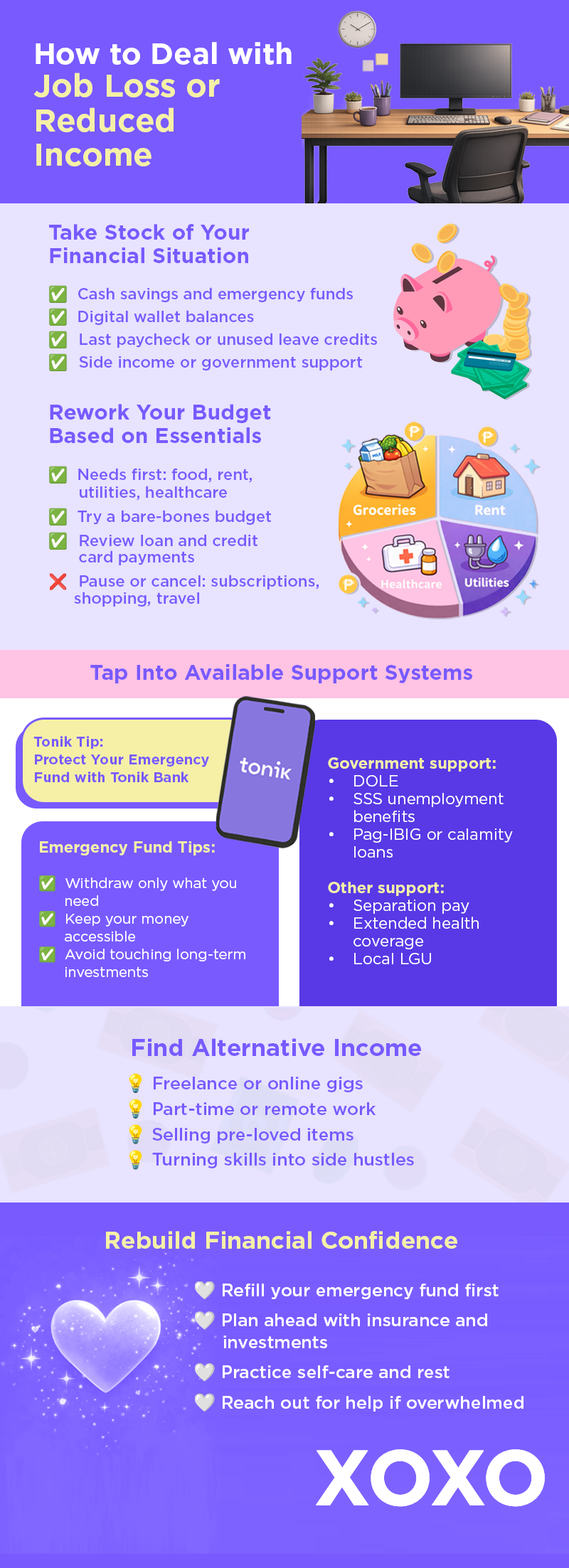
Job loss or reduced income can happen unexpectedly—because of economic shifts, company restructuring, or life changes. It can feel scary, stressful, and overwhelming.
But here’s the good news: learning how to deal with job loss is less about panic and more about preparation, flexibility, and using the right financial tools. This season may be tough, but it’s also temporary—and you don’t have to face it alone.
Step 1: Take Stock of Your Financial Situation
The first step in dealing with job loss is getting a clear picture of your finances. 🧾
Start by listing everything you have:
- Cash savings and emergency funds
- Digital wallet balances
- Last paycheck, separation pay, or unused leave credits
- Any possible side income or government support
Next, look at your monthly expenses and calculate your runway—how many months your current funds can cover your essentials.
Step 2: Rework Your Budget Based on Essentials
When income slows down, your budget should, too.
- Focus on needs first: food, rent or mortgage, utilities, healthcare
- Pause or cancel non-essentials like subscriptions, shopping, and travel
- Try a bare-bones budget until income becomes stable again
- Review loan and credit card payments and explore restructuring options
This part of dealing with job loss may feel uncomfortable—but it’s temporary and meant to protect your stability while things settle. 💜 Learn more on creating a budget here.
Step 3: Protect Your Emergency Fund with Tonik Bank
If you’ve built an emergency fund, this is exactly what it’s meant for—but use it wisely.
- Withdraw only what you need
- Keep your money accessible but earning interest
- Avoid touching long-term investments unless absolutely necessary
👉 Tonik Tip: Park your emergency funds in an Emergency Stash so your money stays liquid while earning higher interest. Learn more about Stashes here.
Step 4: Tap Into Available Support Systems
Knowing how to deal with job loss also means knowing where to ask for help.
Government support options:
- DOLE financial assistance for displaced workers
- SSS unemployment benefits
- Pag-IBIG loan restructuring or calamity loans
Other support you can explore:
- Separation pay or final salary from your employer
- Extended health coverage
- Local LGU or barangay assistance
- Family and community support
There’s no shame in getting help—support systems exist for moments like this. 💪
Step 5: Find Temporary or Alternative Income
While you’re looking for your next role, small income streams can make a big difference. 🧠
- Freelance or online gigs (Upwork, OnlineJobs.ph, Fiverr)
- Part-time or remote work like virtual assistance or tutoring
- Selling pre-loved items on Facebook Marketplace or Carousell
- Turning hobbies or skills into side hustles
Step 6: Manage Debt the Smart Way
Debt can add pressure, so take control early. 💡
- Talk to lenders about grace periods or lower payments
- Prioritize high-interest debts like credit cards
- Avoid informal or high-interest loans unless truly necessary
👉 If you need extra support, consider regulated digital lenders like Tonik Bank, which offers transparent and safer borrowing options such as a Credit Builder Loan to help establish or rebuild your credit history, and a Shop Installment Loan for manageable, buy-now-pay-later purchases—all with clear terms and no hidden surprises.
Step 7: Rebuild Financial Confidence (One Step at a Time)
Once income starts flowing again, focus on rebuilding.
- Refill your emergency fund first
- Keep your simplified budget as your new normal
- Consider automated savings setups (such as Tonik Stash auto-transfers!)
- Plan ahead with insurance, investments, and skill upgrades
Mastering how to deal with job loss isn’t just about surviving—it’s about coming back stronger and smarter. 🚀
Step 8: Take Care of Your Mental and Emotional Health
Money stress is real—and it affects more than just your wallet.
- Practice self-care and rest when needed
- Have honest conversations with your family about finances
- Reach out for help if stress or anxiety feels overwhelming
Remember: recovery takes time. Small wins count. Progress over perfection. ✨
Practical Example: Making Your Savings Last
Scenario:
A worker earning ₱30,000 per month suddenly loses their job and has ₱100,000 in savings to rely on while looking for new income.
Step 1: Adjust Monthly Expenses to Essentials
After switching to a bare-bones budget, monthly expenses look like this:
- Food & groceries: ₱8,000
- Rent / housing share: ₱10,000
- Utilities & internet: ₱3,000
- Transportation & mobile load: ₱2,000
- Healthcare & essentials: ₱2,000
👉 Total monthly essentials: ₱25,000 With this setup, ₱100,000 can cover around 4 months of essential expenses with discipline and careful spending.
Step 2: Use Tonik’s High-Interest Savings to Stretch Funds
Instead of keeping the entire ₱100,000 idle in a regular savings account, the worker:
- Keeps ₱25,000 easily accessible for the first month’s expenses
- Parks the remaining ₱75,000 in a Tonik Stash account
Interest impact:
Solo Stash (around 4% p.a.) earns roughly ₱250+ over 3-4 months
Group Stash (up to 4.5% p.a.) earns even more when saving with family or trusted friends
While this won’t replace income, the extra interest can help cover:
- A utility bill
- Mobile or internet expenses
- A few days’ worth of groceries
Every peso earned helps reduce pressure while funds are limited. 🌱
Why This Works ✅
- Expenses are controlled and predictable
- Savings remain liquid and accessible
- Idle funds continue earning instead of sitting still
- The worker gains breathing room while searching for new income
This practical approach shows how to deal with job loss by combining disciplined budgeting with smarter saving—so your money works for you, even during uncertain times. 💜