Misconceptions About Digital Banks in the Philippines: 10 Myths, Busted
10 Misconceptions About Digital Banks in the Philippines (That Need to Retire)
⚡ Quick Take
No, Luv — most of what you've heard about digital banks is outdated at best, and completely made up at worst. The biggest misconceptions about digital banks in the Philippines — that they're unsafe, unregulated, or "not real banks" — simply don't hold up. BSP- licensed digital banks are just as legitimate , insured, and secure as traditional ones; the only real difference is that yours lives on your phone instead of a building with a queue number. If a titа in your group chat is still side-eyeing your banking app, this list is what you send her.
Digital banking has been around in the Philippines for a few years now, and yet the group chat still has that one titа who insists it's "delikado" or "hindi totoong bangko ." We get it — new things invite doubt, charot! But most of the misconceptions about digital banks in the Philippines floating around are outdated, misinformed, or just plain untrue.
So let's go myth by myth. If you've been on the fence about whether "Is digital banking safe in the Philippines?" is even a fair question to still be asking in 2026 — spoiler: it's not — this one's for you.
Table of Contents
- "10 Misconceptions About Digital Banks in the Philippines (That Need to Retire)"
- 1. "Digital Banks Aren't Real Banks"
- 2. "My Money Isn't Insured Like a Traditional Bank"
- 3. "Digital Banks Are Basically Just E-Wallets"
- 4. "If the Interest Rate Is High, Something's Off"
- 5. "No Branches Means No Access to Cash"
- 6. "There's No One to Talk to If Something Goes Wrong"
- 7. "This Is All Too New and Untested"
- 8. "Opening an Account Requires a Mountain of Paperwork"
- 9. "Digital Banking Is Only for Young, Tech-Savvy People"
- 10. "If the App Crashes, I Lose Access to My Money"
- "Sana All" Stopped Believing the Bad Kind of Hype
1. "Digital Banks Aren't Real Banks"
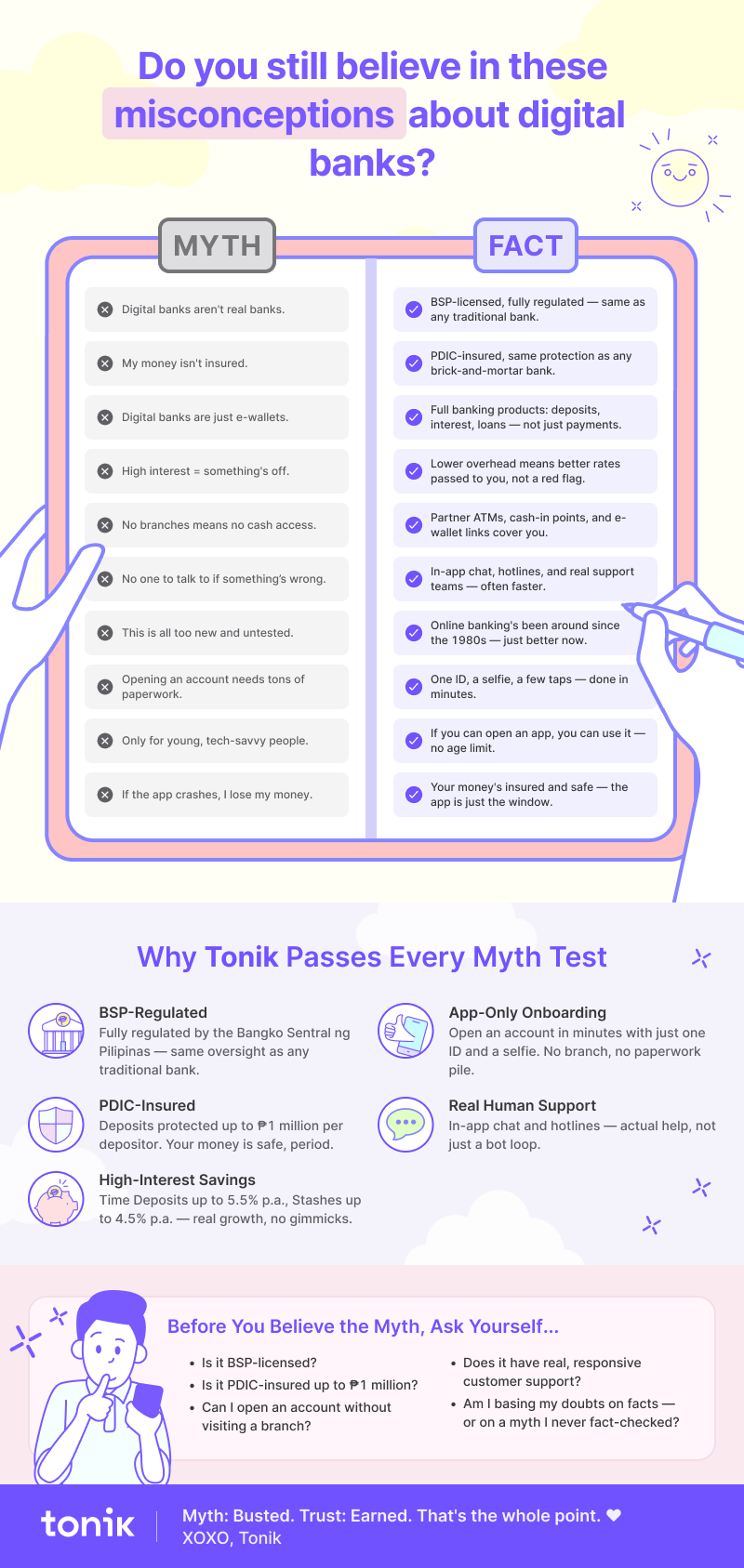
This is probably the biggest of all the misconceptions about digital banks in the Philippines, and also the easiest to bust. It usually comes from the assumption that if there's no branch to point to, there's no "real" institution behind the app — which, fair enough, is an understandable leap if you grew up associating banking with a building and a security guard by the door. But digital banks in the Philippines are licensed by the Bangko Sentral ng Pilipinas (BSP) — the same central bank that regulates the traditional banks your Lola trusts, no exceptions and no shortcuts.
That license isn't a technicality either; it comes with the same capital requirements, compliance checks, and ongoing supervision that any bank has to meet to stay operational. So the app on your phone isn't some independent tech startup playing bank — it's an actual, fully licensed financial institution that happens to skip the physical branch. Same rules, same oversight, same legitimacy. The only difference is you're not walking into a branch to use it, and honestly, most people find that's an upgrade, not a downgrade.
2. "My Money Isn't Insured Like It Would Be in a Traditional Bank"
This myth tends to stick around because insurance feels like the kind of thing that should require paperwork, a signature, and maybe a visit to a branch to "confirm" — so an app-only bank feels like it's skipping a step somewhere. It isn't. Sana all knew this already: deposits in BSP-licensed digital banks are insured by the Philippine Deposit Insurance Corporation (PDIC), the exact same protection your money would get at any brick-and-mortar bank. The coverage isn't a watered-down, digital-only version either — it's the identical protection extended to every PDIC-member bank in the country, traditional or otherwise.
That means if something ever went wrong with the bank itself, your deposit is protected up to the PDIC's coverage limit, no different from how it would work with a bank you can physically walk into. There's no separate, riskier category for digital banks lurking in the fine print. Same safety net, zero drama — the peace of mind was there all along, you just didn't know to look for it.
3. "Digital Banks Are Basically Just E-Wallets"
This is one of the sneakier misconceptions about digital banks in the Philippines, mostly because, to be fair, e-wallets and digital banks do look similar on the surface — both live in an app, both let you send money, both feel modern and convenient. But under the hood, they're built for completely different purposes. Not the same lane, Luv. E-wallets are payment platforms — useful for splitting bills or paying for your Grab, but not licensed to function as banks in the same regulatory sense.
Digital banks are full-fledged, BSP-licensed financial institutions that can accept deposits, pay interest, and offer the same core banking products as any traditional bank, including savings accounts, time deposits, and even loans. The interface might feel similar to your favorite wallet app — same clean design, same tap-to-send convenience — but the foundation underneath is a different (and more regulated) animal entirely. Knowing the difference actually matters, especially if you're deciding where to park your actual savings versus your everyday spending money.
4. "If the Interest Rate Is High, Something's Off"
This is the myth that makes the least sense once you actually think about it, but it persists because "too good to be true" has been drilled into everyone since forever, thanks to actual scams that came before digital banking was even a category. This one's just financial folklore at this point, and it's worth separating the instinct from the facts. High interest rates from a BSP-licensed digital bank aren't a red flag — they're the natural result of lower overhead, plain and simple.
No branches to maintain, no army of tellers to pay, no real estate costs eating into margins every single month. That savings gets passed to you instead of a landlord, which is really just good business, not a trick. If anything, a suspiciously high rate from an unlicensed platform should raise questions — but a competitive rate from a regulated, BSP-licensed bank is just the math working in your favor for once.
5. "No Branches Means No Access to Cash"
This is one of the more persistent misconceptions about digital banks in the Philippines, mostly because cash still feels like the "real" form of money to a lot of people, and not having a branch to walk into for a withdrawal used to genuinely be a limitation. But cash access has caught up, and it's not the dealbreaker it used to be. Most digital banks connect to partner ATM networks, over-the-counter cash-in partners, and linked e-wallets, so you're rarely more than a quick trip away from turning digital pesos into physical ones.
Some partnerships even let you withdraw at convenience stores or partner merchants, which honestly might be closer to you than the nearest traditional bank branch anyway. The infrastructure has matured enough that "no branch" no longer means "no cash" — it just means a different route to get there. For most everyday needs, you'll barely notice the difference.
6. "There's No One to Talk to If Something Goes Wrong"
This is another one of those misconceptions about digital banks in the Philippines that usually comes from a bad experience with some other app somewhere — maybe a chatbot that just loops the same three answers no matter what you type — and it gets unfairly pinned on digital banks as a category. No teller counter doesn't mean no support, though. In-app chat, hotlines, and dedicated customer service teams exist precisely because digital banks know trust is built through responsiveness, not through the appearance of a physical counter.
In fact, most digital banks treat support as a core part of the product, not an afterthought, since there's no branch manager to smooth things over in person — the app itself has to carry that weight. Response times are often faster than what you'd get waiting in a branch line for your turn, if we're being honest about it. The support just looks different: a chat bubble instead of a face, but the actual help behind it is very real.
7. "This Is All Too New and Untested"
This myth comes from how shiny and new the apps look, which makes the whole concept feel like it was invented last year, even though that's not remotely true. The idea feels new because the app on your phone looks polished and modern, but online banking as a concept has existed since the 1980s in various forms around the world. What's evolved isn't the fundamental reliability of digital financial infrastructure — it's the delivery: mobile-first, no paperwork, fewer lines, faster everything.
The Philippines is simply catching up to a wave that other markets have already ridden for years, with the added benefit of learning from what worked (and didn't) elsewhere. So no, you're not a guinea pig testing out some experimental technology — you're using a mature banking model wrapped in a newer, better-designed interface.
8. "Opening an Account Requires a Mountain of Paperwork"
This is one of the more outdated misconceptions about digital banks in the Philippines, and it makes total sense if your only banking reference point is a traditional bank counter and a folder full of forms you had to bring "just in case." But actually the opposite is often true with digital banks. Many digital banks in the Philippines let you open an account entirely through an app, with minimal ID requirements and no in-person visit required at all — no photocopies, no proof of billing, no follow-up trip because you forgot one document.
The whole process usually boils down to one valid government ID, a selfie for facial verification, and a few taps to confirm your details. It's a refreshing contrast to the binder of forms traditional account opening can involve, and it's honestly one of the clearest, most tangible ways digital banks have removed friction from an experience that used to feel like homework. If paperwork has been the thing holding you back from opening an account, this myth is the one most worth letting go of first.
9. "Digital Banking Is Only for Young, Tech-Savvy People"
This one probably comes from marketing that leans heavily on younger, trendy imagery, which can accidentally make it feel like digital banks weren't built with everyone in mind. But convenience isn't an age bracket, and the actual user base tells a different story than the marketing sometimes implies. If you can send a text or open an app, you can use a digital bank — the interfaces are generally designed to be simpler than traditional online banking portals, not more complicated.
The design intent is ease, not exclusivity, and that includes people who wouldn't necessarily call themselves "tech-savvy" by any stretch. Plenty of non-"digital native" Filipinos, including parents and even lolos and lolas, have made the switch simply because it's less of a hassle, not because they wanted to feel trendy or keep up with younger relatives. At the end of the day, an app that saves you a trip to a branch is just as useful at 60 as it is at 20.
10. "If the App Crashes, I Lose Access to My Money"
This might be the most anxiety-inducing of all the misconceptions about digital banks in the Philippines, and understandably so — nobody wants to imagine their savings disappearing because of a glitch. But a temporary app hiccup isn't the same as losing your funds, and conflating the two is where this misconception goes wrong. Your money lives with a BSP-licensed, PDIC-insured institution — not inside the app itself, and definitely not inside your phone. The app is simply the window you use to view and manage an account that exists independently on the bank's actual systems, backed by the same regulatory infrastructure as any traditional bank.
Outages get fixed like any technical issue would, and your balance stays exactly where it should be the entire time, untouched and unaffected by whatever's happening on the interface side. If it helps, think of it less like your money living in the app, and more like the app being a really convenient window into money that's safely elsewhere the whole time.
"Sana all" stopped believing the bad kind of hype
Here's the tea, Luv ☕ — most misconceptions about digital banks in the Philippines come from outdated assumptions, not current facts. The honest answer to "Is digital banking safe in the Philippines?" is yes, as long as you're banking with a BSP-licensed, PDIC-insured institution. Not delikado, and no drama — just banking that happens to live on your phone instead of a building.
Kilig-worthy rates. Real regulation. Zero mountain of paperwork. That's the whole point, Luv.
XOXO,
Tonik 💜